


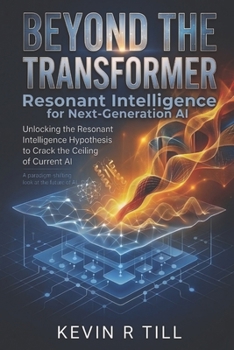
Beyond the Transformer: Resonant Intelligence for Next-Generation AI

The most capable Artificial Intelligence (AI) systems ever built are also, in a fundamental way, wrong.
Not wrong about facts. Not wrong about language. Wrong at the architectural level - built on a model of intelligence that has a ceiling, and that ceiling is closer than the field is publicly acknowledging.
Beyond the Transformer is a rigorous, practitioner-written argument about what intelligence actually is, physically and mathematically - and what that means for the AI we are building next.
The argument draws on three independent research programs that are rarely discussed together. A biologist at Tufts University discovered that intelligence is not a property of brains but a general property of biological organization, present at every scale of living matter. A physicist in Tsukuba, Japan found that the protein structures inside neurons are extraordinarily sophisticated information-processing devices, organized according to mathematical principles that connect them to the deepest geometry of the physical universe. And a computer scientist at Google arrived, through years of building the most capable AI systems in the world, at the conclusion that something essential is missing from the architecture of those systems - something that separates even the most capable transformer from biological-level agency.
What these three researchers found, working independently and from entirely different directions, converges on the same core conclusion: that genuine intelligence is a specific physical process - coherent, multi-scale resonance with the geometric structure of reality - and that no transformer-based system, however large, can instantiate it.
That synthesis is the Resonant Intelligence Hypothesis - the book's central contribution, and the framework that changes the question the AI field should be asking.
This book is for you if:
You build, deploy, or fund AI systems and want to understand why the failure modes persist regardless of scaleYou are technically serious but dissatisfied with the explanations available for what current AI cannot doYou are a product leader, researcher, or investor trying to evaluate which architectural bets will look prescient in ten yearsYou want to understand what the science actually says about intelligence - not the marketing version
What you will find inside:
Beyond the Transformer does not argue that the systems we have built are failures. They are extraordinary achievements. The argument is that they are the best possible version of a fundamentally bounded approach - and that a different approach, supported by serious science and currently being almost entirely ignored by the mainstream of AI development, now exists.
The next generation of AI will be built on a different physical principle. This book is an attempt to make that principle visible before the architectures of the next decade are locked in.
Kevin R Till is a product strategist, developer, and AI practitioner who has spent years using, building, and deploying AI-powered systems.
Customer Reviews
ThriftBooks ® and the ThriftBooks ® logo are registered trademarks of Thrift Books Global, LLC
