
Skip to content
Scan a barcode
Scan
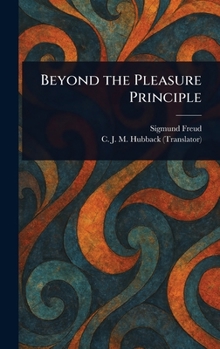
Hardcover Beyond the Pleasure Principle Book

ISBN: 1025243285

ISBN13: 9781025243283

Beyond the Pleasure Principle

Select Format

Select Condition ThriftBooks Help Icon

Recommended

Format: Hardcover

Condition: New

$30.95
50 Available
Ships within 2-3 days

Book Overview

Sigmund Freud's pivotal work, "Beyond the pleasure principle," stands as a landmark text in the history of psychological theory. In this profound inquiry, Freud delves into the foundational concepts of psychoanalysis, initially examining the widely accepted notion of the pleasure principle-the idea that human behavior is primarily driven by the pursuit of pleasure and the avoidance of pain. However, Freud then courageously challenges this very principle, venturing into more complex and often unsettling aspects of the human psyche.

This concise yet deeply influential study introduces readers to Freud's groundbreaking explorations of repetitive behavior, trauma, and the concept of the death drive, moving into the realm of metapsychology. It offers a radical re-evaluation of fundamental human drives and motivations, expanding the scope of psychoanalytic thought significantly. "Beyond the pleasure principle" is an indispensable resource for anyone interested in the core theories of psychoanalysis, the evolution of psychological thought, or the philosophical underpinnings of human existence. It continues to provoke thought and inspire discussion in the fields of psychology and philosophy, making it a timeless contribution to our understanding of the mind.

This work has been selected by scholars as being culturally important, and is part of the knowledge base of civilization as we know it.

This work is in the public domain in the United States of America, and possibly other nations. Within the United States, you may freely copy and distribute this work, as no entity (individual or corporate) has a copyright on the body of the work.

Scholars believe, and we concur, that this work is important enough to be preserved, reproduced, and made generally available to the public. We appreciate your support of the preservation process, and thank you for being an important part of keeping this knowledge alive and relevant.

Customer Reviews

5 ratings

Compulsion to Repeat

Essentially explains why many of us repeat destructive behaviors over and over. This is a short book, but anything but a "quick read". Unless you were a psych major it's gonna be tough going. But definitely worth the time. Of course Freud was one of the greatest thinkers of the 20th century. Surprisingly, recommended for Day Traders, of which I am one.

Brilliant

This little book is indubitable proof of the breadth and depth of Freud's thinking. It is a fascinating and multi-faceted read, containing elements of psychoanalysis, philosophy, poetry, biology, and the literary theory. You will not believe how quickly Freud is able to move from topic to topic and the absurd range within which he is able to speculate. This is also an extraordinarily challenging read, it requires patience and many re-readings. Freud discusses the compulsion to repeat, transference neurosis, life and death drives, and a number of other cognitive and behavioral topics.Here is a curious quote I adore: "In the last resort, what has left its mark on the development of organisms must be the history of the earth we live in and its relation to the sun" (pg. 45). Beyond the Pleasure Principle is a seminal component of his expansive corpus, and should be standard reading for psychologists.

Happy, Deadly, Wild Psychology!

Sigmund Freud's "Beyond the Pleasure Principle" is a key text, not only for psychologists, or literary theorists, but anyone who thinks about why our minds work the way they do. If your mind is open to extreme possibilities, give this text a read. It is short, barely 75 pages, but give yourself time to pore over and make notes, as Freud moves very quickly.In "Beyond the Pleasure Principle," Freud seeks to discover the causes and effects of our drives. To this end, he begins with the pleasure principle, which basically holds that the job of our 'mental apparatus' is to lower tension and move us towards pleasure and stability. Working against the pleasure principle are our baser instincts, which must be repressed by a vigilant brain. The pleasure principle can also be interrupted by the reality principle, which operates in moments when basic life functions are threatened - to wit, when maintaining life is more important than pleasure. Examining the pleasure principle, Freud looks at scenarios which may shed light on mental processes that seem to challenge it. These include repetition compulsion, wherein adults seem to fixate and reenact moments of trauma. Seeking a more primal cause for repetition instinct, Freud analyses children's games. Interestingly, the further Freud regresses, the more speculative and intense he gets - from childhood, Freud talks about the brain itself, moving back to simple multicellular organisms, unicellular organisms, and ultimately inorganic matter - all the time looking for an explanation of the origin of instincts themselves.Freud's queries on instinct and repetition compulsion lead him to the darkest possible places - the revelation of the death instinct. Freud posits that the repetition compulsion manifests itself in all conscious beings in the desire to return to the earliest state, total inactivity. The remainder of his treatise is spent developing the conditions of the death instinct, and trying to find a way out of this shocking thesis. Taking up Hesiodic Eros as symbolic of the life instinct, Freud attempts to argue out of the seemingly inescapable conclusion.Freud's writing style is direct and fluid, but not necessarily straightforward. If you're not paying attention, Freud can go over your head quickly. For example, on page 50 of this standard edition, his line of argument dismisses Darwin, Marx, and Nietzsche in a matter of two paragraphs to astounding effect. His language is highly figurative, drawing on philosophy, literature, biology, and anecdote to make and illustrate his points. A critical text for anyone interested in psychoanalysis and its figurehead author.

a classic not for beginners....

....but a daring example of the willingness of a thinker to make fundamental changes to his theoretical framework very late in his career. This is where Freud shifts his emphasis from ego vs. id instincts to the famous Eros/death polarity, clinically questionable but archetypally informative.

Beyound Psycho-analysim

Freud did a remarkable job of reinstateing, and clearifying exsisting established beliefs, In this his finale publishcation. Although it is a bit wordy on occassions, a even a bit (dare i say) nonsenseacal. It is a enlightning and fasanating piece of work. And though I would'nt recommend it for new-comers to the world of psyco-analysim, it is diffently worth reading.
Copyright © 2026 Thriftbooks.com Terms of Use | Privacy Policy | Do Not Sell/Share My Personal Information | Cookie Policy | Cookie Preferences | Accessibility Statement
ThriftBooks® and the ThriftBooks® logo are registered trademarks of Thrift Books Global, LLC

GoDaddy Verified and Secured