


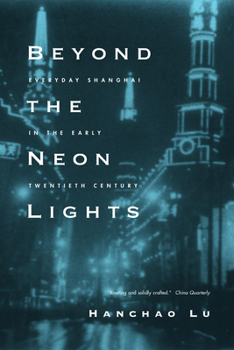
Beyond the Neon Lights: Everyday Shanghai in the Early Twentieth Century

Select Format
Select Condition 
Book Overview
How did ordinary people live through the extraordinary changes that have swept across modern China? How did peasants transform themselves into urbanites? How did the citizens of Shanghai cope with the epic upheavals-revolution, war, and again revolution-that shook their lives? Even after decades of scholarship devoted to modern Chinese history, our understanding of the daily lives of the common people of China remains sketchy and incomplete. In this carefully researched study, Hanchao Lu weaves rich documentary data with ethnographic surveys and interviews to reconstruct the fabric of everyday life in China's largest and most complex city in the first half of this century.
Format:Paperback
Language:English
ISBN:0520243781
ISBN13:9780520243781
Release Date:September 2004
Publisher:University of California Press
Length:456 Pages
Weight:1.53 lbs.
Dimensions:1.2" x 6.0" x 9.0"
Customer Reviews
1 rating
The truest portrait of Shanghai as it was and as it is
Published by Thriftbooks.com User , 23 years ago
If you are looking to understand the enigma that is Shanghai, then look no further than Mr. Lu's incredibly insightful "Beyond the Neon Lights". It could be subtitled: "Beyond the hype, the myths, the stereotypes and the cliches," but Mr. Lu is an academic, and uses sound research to sell his books rather than sensationalism. Bravo for him, I say.Shanghai history books - the sensationalist, badly researched ones, at least - tend to present an Old Shanghai of Gangsters, Bankers, Hookers, and Foreigners...oh my! Even the more thorough ones present mostly the wild advantures of those wacky expatriates, ignoring or neglecting the role and the life of the "laobaixing", the ordinary people of Shanghai."Beyond the Neon Lights" fills this very large gap amazingly well. It is dedicated to life in the lanes that were and are the arteries of the city, the source of its lifeblood, the petty urbanites. Lu explores the architecture of the Shikumen, the typical pre-1920s Shanghai lane dwelling, and explains how its system of sub-sub- and sub-letting fomented the complicated communities that emerged there. He also conveys how the social structures and cultural habits changed with the introduction of more modern lanes (with indoor plumbing, fewer households, etc) and the Art Deco highrises. Every aspect of life in Shanghai was and often still is structured around the lane neighborhood. Although the new-style lanes are less contained, more open, and thus less of a microcosm, both vintages boast their own economy of scale. There is the old-style convenience store, the "tobacco and paper shop", at the entrance, plus a tailor, produce dealer, shoe-repairman, locksmith, pharacist...and more in the larger lanes. Other needs were serviced by the itineret peddlars, selling goods or repairing them or buying rubbish. The latter, Lu explains, were the main source of income for the housekeepers of the middle class.The roving peddlers still ply their trade in Shanghai's remaining lanes; all that has changed are their regional backgrounds and some of their wares. But now, as then, they are distinguished by the ditties they sing to announce their arrival. I awake every morning to the tune of one of the three rice vendors who frequents my lane; he is followed by a series of seasonal fruit vendors, the chicken man, the beer man, and the used electronic buyers. About once a week the wicker chair repairman wanders by. The travelling cobbler skirts my street, since he has three permanent competitors on the block, but I see and hear him elsewhere. I rarely use their services, but I love hearing them: they make Shanghai Shanghai.Lu also documents the migration patterns that configured the people who normally count themselves as Shanghainese. The relatively high-class ones came from Ningbo, Hangzhou and elsewhere in Zhejiang Province, the middle class from Jiangsu south of the Yangtze, and the dregs from north of the Yangtze. "Beyond the Neon Lights" goes into interesting depths about
Copyright © 2026 Thriftbooks.com Terms of Use
| Privacy Policy | Do Not
Sell/Share My Personal Information | Cookie Policy | Cookie Preferences | Accessibility Statement
ThriftBooks® and the ThriftBooks® logo are registered trademarks of Thrift Books Global, LLC
ThriftBooks® and the ThriftBooks® logo are registered trademarks of Thrift Books Global, LLC
