


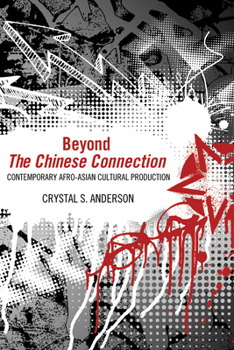
Beyond "The Chinese Connection": Contemporary Afro-Asian Cultural Production
No Customer Reviews

Select Format
Select Condition 
Book Overview
From Bruce Lee to Samurai Champloo, how Asian fictions fuse with African American creative sensibilities In this study, Crystal S. Anderson explores the cultural and political exchanges between African Americans, Asian Americans, and Asians over the last four decades. To do so, Anderson examines such cultural productions as novels (Frank Chin's Gunga Din Highway 1999], Ishmael Reed's Japanese by Spring 1992], and Paul Beatty's The White Boy Shuffle 1996]); films (Rush Hour 2 2001], Unleashed 2005], and The Matrix trilogy 1999-2003]); and Japanese animation (Samurai Champloo 2004]), all of which feature cross-cultural conversations. In exploring the ways in which writers and artists use this transferral, Anderson traces and tests the limits of how Afro-Asian cultural production interrogates conceptions of race, ethnic identity, politics, and transnational exchange. Ultimately, this book reads contemporary black/Asian cultural fusions through the recurrent themes established by the films of Bruce Lee, which were among the first--and certainly most popular--works to use this exchange explicitly. As a result of such films as Enter the Dragon (1973), The Chinese Connection (1972), and The Big Boss (1971), Lee emerges as both a cross-cultural hero and global cultural icon who resonates with the experiences of African American, Asian American, and Asian youth in the 1970s. Lee's films and iconic imagery prefigure themes that reflect cross-cultural negotiations with global culture in post-1990 Afro-Asian cultural production. Crystal S. Anderson, Elon, North Carolina, is an associate professor of English at Elon University. Her work has been published in African American Review, MELUS, Extrapolation, and Ethnic Studies Review.
Format:Paperback
Language:English
ISBN:1496802535
ISBN13:9781496802538
Release Date:January 2015
Publisher:University Press of Mississippi
Length:222 Pages
Weight:0.76 lbs.
Dimensions:0.5" x 6.0" x 9.0"
Customer Reviews
0 rating
Copyright © 2026 Thriftbooks.com Terms of Use
| Privacy Policy | Do Not
Sell/Share My Personal Information | Cookie Policy | Cookie Preferences | Accessibility Statement
ThriftBooks® and the ThriftBooks® logo are registered trademarks of Thrift Books Global, LLC
ThriftBooks® and the ThriftBooks® logo are registered trademarks of Thrift Books Global, LLC
