


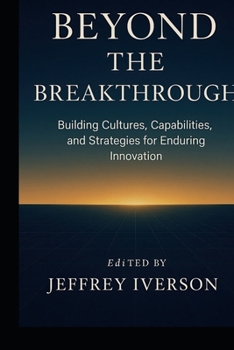
Beyond the Breakthrough: Building Cultures, Capabilities, and Strategies for Enduring Innovation

Beyond the Breakthrough argues that innovation is no longer defined by flashes of insight or isolated moments of creativity. Instead, enduring innovation emerges from the cultures, capabilities, and strategic systems that allow organizations to learn, adapt, and renew themselves continuously. The book reframes innovation as an ecosystem-one that requires intention, discipline, and responsibility at every level of the organization.
The collection opens by challenging the myth of the breakthrough. Ideas matter, but they are only the beginning. What differentiates resilient, future-ready organizations is their ability to turn ideas into sustained value. This requires cultures that encourage curiosity, psychological safety, and cross-functional collaboration. Innovation thrives where people feel empowered to experiment, challenge assumptions, and learn from failure without fear.
Capabilities form the second pillar of enduring innovation. Organizations must develop the ability to sense emerging trends, prototype quickly, test rigorously, and scale responsibly. Agility is essential, but it must be paired with systems that support evidence-based decision-making, portfolio thinking, and the balance between exploration and execution. Innovation becomes a repeatable practice rather than a sporadic event.
The book also emphasizes the ethical and societal dimensions of innovation. As technology becomes more powerful and pervasive, innovators must consider the human impact of their decisions. Responsible innovation requires fairness, transparency, privacy, and accountability. It demands that organizations anticipate unintended consequences and design solutions that enhance human well-being rather than undermine it. Sustainability and regeneration extend this responsibility further, urging businesses to create value that strengthens ecological and social systems instead of depleting them.
Another central theme is resilience. Markets shift, technologies evolve, and assumptions expire. Organizations that endure are those that treat change as a catalyst rather than a threat. They build adaptive structures, invest in continuous learning, and cultivate leaders who model humility, clarity, and courage. Resilience is not merely the ability to withstand disruption; it is the ability to transform through it.
Throughout the essays, the role of the innovator expands beyond creativity. Innovators become sensemakers who interpret complexity, bridge builders who connect disciplines, ethical stewards who safeguard trust, and storytellers who help others see possibility. Their work is as much about shaping mindsets and systems as it is about generating ideas.
In its final movement, the book argues that the future will belong to organizations that move beyond the breakthrough-those that embed innovation into their identity, align it with purpose, and pursue it with responsibility. Enduring innovation is not a race toward novelty but a commitment to continuous renewal. It is a long-term practice rooted in culture, capability, and care.
Beyond the Breakthrough ultimately offers a blueprint for organizations that want to innovate not just once, but always. It invites leaders and teams to build systems that are imaginative, ethical, resilient, and regenerative-systems capable of shaping a future defined not by disruption alone, but by possibility.
Customer Reviews
ThriftBooks® and the ThriftBooks® logo are registered trademarks of Thrift Books Global, LLC
