


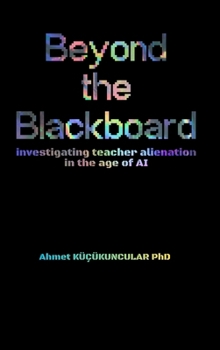
Beyond the Blackboard: investigating teacher alienation in the age of AI

Artificial intelligence is increasingly presented as a tool for improving efficiency, autonomy, and innovation in education. But what does AI mean for teachers as workers?
Beyond the Blackboard offers a critical examination of how artificial intelligence reshapes teaching labour, professional identity, and autonomy. Drawing on empirical research and critical theory, the book explores how AI driven systems influence teachers' control over their work, their relationship to educational outcomes, and their sense of meaning and fulfilment within institutional settings.
Grounded in Marxist theories of alienation and contemporary debates in AI ethics, the book analyses education not simply as a site of technological adoption, but as a workplace increasingly shaped by algorithmic management, performance metrics, and data driven governance. It challenges optimistic narratives that frame AI as inherently empowering, instead asking how structural conditions shape teachers' lived experiences of technological change.
Written in an accessible but academically rigorous style, Beyond the Blackboard will be of interest to scholars, postgraduate students, educators, and policymakers concerned with artificial intelligence in education, teacher autonomy, and the ethical implications of educational technology. The book contributes to ongoing discussions in educational philosophy, AI ethics, and the political economy of education by foregrounding labour, power, and alienation in the age of intelligent systems.
This work is a revised and lightly edited version of the author's doctoral dissertation.
Customer Reviews
ThriftBooks ® and the ThriftBooks ® logo are registered trademarks of Thrift Books Global, LLC
