


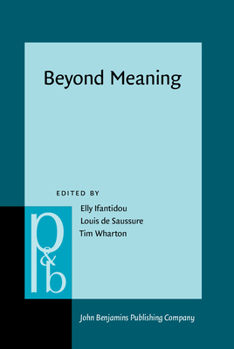
Beyond Meaning (Pragmatics & Beyond New Series)
No Customer Reviews

Despite the fact that they are often crucial to our understanding, the vague, ineffable elements of language use and communication have received much less attention from linguists than the more concrete, effable ones. This has left a range of important questions unanswered. How might we account for the communication of non-propositional phenomena such as moods, emotions and impressions? What type of cognitive response do these phenomena trigger, if not conceptual or propositional? Do creative metaphors and unknown words in second languages and other 'pointers' to 'conceptual regions' communicate concepts learned from language alone? How might the descriptive ineffability of interjections, free indirect speech etc. be accommodated within a theory of communication? What of those working on the aesthetics of artworks, music and literature? What can evolution tell us about ineffability? The papers in this volume address these fascinating questions head-on. They represent a range of different attempts to answer them and, in so doing, allow us to pose exciting new questions. The aim, to bring the ineffable firmly within the grasp of theoretical pragmatics.
Format:Hardcover
Language:English
ISBN:902720926X
ISBN13:9789027209269
Release Date:November 2021
Publisher:John Benjamins Publishing Company
Length:206 Pages
Weight:1.15 lbs.
Dimensions:9.5" x 0.5" x 6.5"
Related Subjects
Language ArtsCustomer Reviews
0 rating
Copyright © 2025 Thriftbooks.com
Terms of Use | Privacy Policy | Do Not Sell/Share My Personal Information | Cookie Policy | Cookie Preferences | Accessibility Statement
ThriftBooks ® and the ThriftBooks ® logo are registered trademarks of Thrift Books Global, LLC
ThriftBooks ® and the ThriftBooks ® logo are registered trademarks of Thrift Books Global, LLC
