


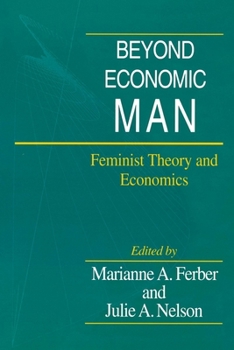
Beyond Economic Man: Feminist Theory and Economics

Select Format
Select Condition 
Book Overview
This is the first book to examine the central tenets of economics from a feminist point of view. In these original essays, the authors suggest that the discipline of economics could be improved by freeing itself from masculine biases. Beyond Economic Man raises questions about the discipline not because economics is too objective but because it is not objective enough. The contributors-nine economists, a sociologist, and a philosopher-discuss the extent to which gender has influenced both the range of subjects economists have studied and the way in which scholars have conducted their studies. They investigate, for example, how masculine concerns underlie economists' concentration on market as opposed to household activities and their emphasis on individual choice to the exclusion of social constraints on choice. This focus on masculine interests, the contributors contend, has biased the definition and boundaries of the discipline, its central assumptions, and its preferred rhetoric and methods. However, the aim of this book is not to reject current economic practices, but to broaden them, permitting a fuller understanding of economic phenomena. These essays examine current economic practices in the light of a feminist understanding of gender differences as socially constructed rather than based on essential male and female characteristics. The authors use this concept of gender, along with feminist readings of rhetoric and the history of science, as well as postmodernist theory and personal experience as economists, to analyze the boundaries, assumptions, and methods of neoclassical, socialist, and institutionalist economics. The contributors are Rebecca M. Blank, Paula England, Marianne A. Ferber, Nancy Folbre, Ann L. Jennings, Helen E. Longino, Donald N. McCloskey, Julie A. Nelson, Robert M. Solow, Diana Strassmann, and Rhonda M. Williams.
Format:Paperback
Language:English
ISBN:0226242013
ISBN13:9780226242019
Release Date:June 1993
Publisher:University of Chicago Press
Length:186 Pages
Weight:0.72 lbs.
Dimensions:0.6" x 6.1" x 9.0"
Customer Reviews
1 rating
Foundational text in feminist economics
Published by Thriftbooks.com User , 16 years ago
The articles in this volume - from England's piece on the "separative self," to Strassmann's work on the rhetoric of economics, to Nelson's work on the goal of economic theorizing - are classics in the field, essential reading for anyone interested in the subject of feminist economics. If only mainstream econmics took this material more seriously . . . .
Copyright © 2026 Thriftbooks.com
Terms of Use | Privacy Policy | Do Not Sell/Share My Personal Information | Cookie Policy | Cookie Preferences | Accessibility Statement
ThriftBooks ® and the ThriftBooks ® logo are registered trademarks of Thrift Books Global, LLC
ThriftBooks ® and the ThriftBooks ® logo are registered trademarks of Thrift Books Global, LLC
