


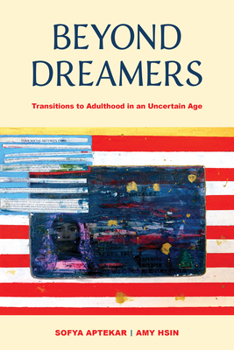
Beyond Dreamers: Transitions to Adulthood in an Uncertain Age

The typical image of a Dreamer is an undocumented Latinx youth--brought to the U.S. through no choice of their own--who excels academically and aspires to contribute to the U.S. economy. This image has engendered political good will and helped push through an executive order that created Deferred Action for Childhood Arrivals, but it is limited. It fails to account for the full spectrum of diversity among undocumented youth. It also leaves the Dreamer figure stuck in a stage of youth and innocence waiting for immigration reform to allow them to finally transition to adulthood. There is little room in the Dreamer narrative for navigating complex family obligations, employment, entering adult relationships, or other markers of adulthood. In Beyond Dreamers, sociologists Sofya Aptekar and Amy Hsin examine how undocumented young adults navigate the transition to adulthood.
Drawing on more than one hundred interviews with a racially and ethnically diverse group of undocumented college students in New York City, with and without DACA authorization, Aptekar and Hsin show that there is no single undocumented experience. They find that while legal status matters enormously, its impacts are influenced by race, national origin, gender, class, sexuality, family resources, educational institutions, neighborhood contexts, and access to local and transnational co-ethnic communities and labor markets. These forces not only shape the kinds of opportunities available to undocumented young adults, but how they choose to approach disclosing their undocumented status and interact with family, peers, employers, professors, and police.
Aptekar and Hsin pay particular attention to the effect of one's mode of entry into the United States, highlighting the distinction between visa overstayers and those who entered the country without inspection. This highly consequential divide shapes early experiences of illegality, labor market options, exposure to surveillance and precarity, and the possibility of adjusting status. Individuals who overstay their visas have more avenues to adjust their undocumented status, including family sponsorship and marriage to U.S. citizens. Opportunities for legalization are much more restricted for those who made unauthorized border crossings. If these immigrant youth want to adjust their status, they are required to leave the country and remain abroad for at least ten years to do so. Other methods of adjusting their status, such as claiming extreme hardship on their American families or trying to obtain visas for victims of crime or parental abuse or neglect, are extremely difficult to obtain, costly, and can lead to division in families, making legalization all but impossible and, therefore, limiting youths' opportunities. Thus, mode of entry strongly influences how some young adults imagine their future lives in the U.S. and beyond.
Beyond Dreamers deftly underscores how deeply legal uncertainty continues to structure the lives of undocumented young adults.
Customer Reviews
ThriftBooks ® and the ThriftBooks ® logo are registered trademarks of Thrift Books Global, LLC
