


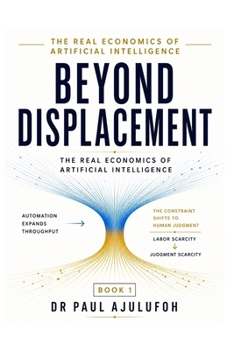
Beyond Displacement: The Real Economics of Artificial Intelligence

Beyond Displacement: The Real Economics of Artificial Intelligence
Artificial intelligence is widely described as a force that replaces jobs, increases productivity, and accelerates economic growth. That interpretation captures visible changes, but it fails to explain how the underlying system is evolving.This book presents a different framework for understanding AI and the economy.
Rather than focusing on job displacement alone, it examines how artificial intelligence reshapes economic constraints. Automation reduces friction in routine and lower-level cognitive tasks, increasing throughput across the system. As output expands, pressure does not disappear-it shifts. The constraint moves upward into human decision-making, where judgment, not computation, determines outcomes.
This transition defines a new economic reality:
the movement from labor scarcity to judgment scarcity.
Through a structured analysis of labor markets, productivity, and system behavior, this book introduces a model of the economy as a constraint-driven system. It explains how AI-driven automation compresses time, increases decision volume, and concentrates pressure on high-responsibility roles. As cognitive load rises, decision quality becomes a critical variable-one that degrades under stress and creates hidden instability within otherwise stable systems.
Key themes explored include:
- The limits of productivity growth in an AI-driven economy
- The relationship between automation, labor displacement, and wage dynamics
- The emergence of judgment scarcity as a binding economic constraint
- Cognitive bandwidth, decision fatigue, and economic output
- Nonlinear declines in decision quality under pressure
- Structural shifts in labor markets across routine, middle-skill, and high-responsibility work
- The buildup of hidden strain beneath stable economic indicators
This is not a book about specific technologies or tools. It is a system-level analysis of artificial intelligence and its impact on economics, labor markets, and productivity dynamics.
Designed for investors, strategists, and analytical readers, it provides a framework for interpreting how AI is reshaping economic structure-not through visible disruption alone, but through the reallocation of constraints within the system.
Understanding that shift is critical for navigating the next phase of economic change.
Customer Reviews
ThriftBooks ® and the ThriftBooks ® logo are registered trademarks of Thrift Books Global, LLC
