


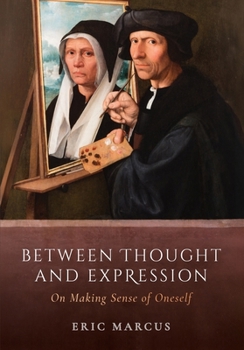
Between Thought and Expression: On Making Sense of Oneself
No Customer Reviews

What does it mean to say what you think? In Between Thought and Expression, Eric Marcus argues that the relationship between a thought and its expression in language is more intimate than philosophers have supposed. We do not first form a belief, intention, or desire, and then find words to report it; rather, the ability to put a thought into words is part of what makes it the thought it is, and a rational creature's thought is no more determinate than her ability to articulate it. Understanding what someone is saying is therefore not a matter of inferring the speaker's state of mind from the words she utters, but of grasping the sense she is making with them. Variants of Moore's Paradox —conjunctions of independently meaningful statements that somehow fail to make sense —are shown to arise across a striking range of domains: intentional action, desire, moral exhortation, aesthetic judgment, and validity. Tracking these Moore-style phenomena, Marcus argues that our attitudes in each domain are partly constituted by the thinker's capacity to avow them —a capacity whose exercises, properly understood, are themselves applications of the standard of appropriateness to which the attitude is answerable. Through seven examples of a single phenomenon —independently meaningful statements that somehow fail to make sense in combination —Marcus develops this thesis across belief, action, desire, moral advice, aesthetic judgment, and logical inference, offering a unified picture of the rational mind.
Format:Hardcover
Language:English
ISBN:0197871070
ISBN13:9780197871072
Release Date:November 2026
Publisher:Oxford University Press
Length:240 Pages
Related Subjects
PhilosophyCustomer Reviews
0 rating
Copyright © 2026 Thriftbooks.com
Terms of Use | Privacy Policy | Do Not Sell/Share My Personal Information | Cookie Notice | Cookie Preferences | Accessibility Statement
ThriftBooks ® and the ThriftBooks ® logo are registered trademarks of Thrift Books Global, LLC
ThriftBooks ® and the ThriftBooks ® logo are registered trademarks of Thrift Books Global, LLC
