


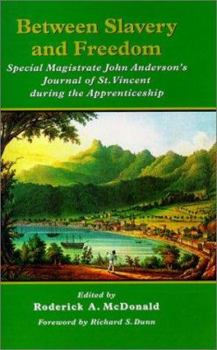
Between Slavery and Freedom: Special Magistrate John Anderson's Journal of St. Vincent During the Apprenticeship (Early American Studies)
No Customer Reviews

"Anderson's view of the emancipation process stands surrogate for a great many other well-meaning Britons and Americans in the nineteenth century who combined antislavery with racism, and who worked to achieve freedom for the blacks--but on exceedingly restrictive terms."--from the Foreword
On August 1, 1834, more than 20,000 African slaves were emancipated in the British Caribbean. As in other areas of the British Empire, however, only slave children under six years of age were freed immediately. The rest were apprenticed to their former owners for a stipulated term of four to six years. It was during this time that more than one hundred men were appointed as special magistrates to oversee and arbitrate between the ex-slaves and their former owners. Among them was John Anderson, a Scottish lawyer, who arrived on the island of St. Vincent in 1836. An uninhibited racist, he ironically became a central player in Caribbean emancipation. For the next two and a half years Anderson compiled a journal describing in extraordinary detail the relationship between the remaining enslaved population, free blacks, and their former owners. His journal documents the lives of different castes of slaves, and also those of whites who lived on the island. While he found all residents--white and black--of St. Vincent uncultured, his writings shed light on the island's institutions, the activities of the free colored population, and the character of the towns and rural life, as well as fascinating glimpses of the island's topography, flora, and fauna. Between Slavery and Freedom contains the complete text of John Anderson's journal, with Roderick McDonald's extensive annotation. It is a significant addition to the scholarship on this important era of British West Indies's history. A highly informative introduction provides a rich context in which to understand this major account of Caribbean society during the period of emancipation.Format:Hardcover
Language:English
ISBN:0812235967
ISBN13:9780812235968
Release Date:April 2000
Publisher:University of Pennsylvania Press
Length:304 Pages
Weight:1.30 lbs.
Dimensions:9.3" x 1.0" x 6.3"
Customer Reviews
0 rating
Copyright © 2026 Thriftbooks.com Terms of Use
| Privacy Policy | Do Not
Sell/Share My Personal Information | Cookie Policy | Cookie Preferences | Accessibility Statement
ThriftBooks® and the ThriftBooks® logo are registered trademarks of Thrift Books Global, LLC
ThriftBooks® and the ThriftBooks® logo are registered trademarks of Thrift Books Global, LLC
