



Select Format
Select Condition 
Book Overview
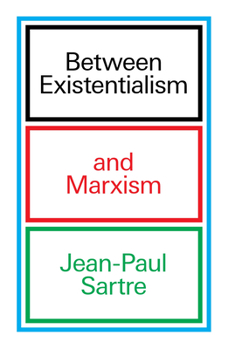
This book presents a full decade of Sartre's work, from the publication of the Critique of Dialectical Reason in 1960, the basic philosophical turning-point in his postwar development, to the inception of his major study on Flaubert, the first volumes of which appeared in 1971. The essays and interviews collected here form a vivid panorama of the range and unity of Sartre's interests, since his deliberate attempt to wed his original existentialism to a rethought Marxism. A long and brilliant autobiographical interview, given to New Left Review in 1969, constitutes the best single overview of Sartre's whole intellectual evolution. Three analytic texts on the US war in Vietnam, the Soviet invasion of Czechoslovakia, and the lessons of the May Revolt in France, define his political positions as a revolutionary socialist. Questions of philosophy and aesthetics are explored in essays on Kierkegaard, Mallarme and Tintoretto. Another section of the collection explores Sartre's critical attitude to orthodox psychoanalysis as a therapy, and is accompanied by rejoinders from colleagues on his journal Les Temps Modernes. The volume concludes with a prolonged reflection on the nature and role of intellectuals and writers in advanced capitalism, and their relationship to the struggles of the exploited and oppressed classes. Between Existentialism and Marxism is an impressive demonstration of the breadth and vitality of Sartre's thought, and its capacity to respond to political and cultural changes in the contemporary world.
Format:Paperback
Language:English
ISBN:1804296171
ISBN13:9781804296172
Release Date:January 2025
Publisher:Verso
Length:304 Pages
Weight:0.50 lbs.
Dimensions:0.8" x 5.3" x 8.3"
Customer Reviews
1 rating
The best of Jean Paul Sartre's Mind
Published by Thriftbooks.com User , 17 years ago
Always lucid, profound and ever irreverent, this is a delicious collections of reprints and interviews on the "whys" and "why nots" of Sartre's century of intellectual and political ideas. Here is a once in a life time "head session" that covers the waterfront - from Existentialism to Marxism, from Genet and Tintoretto to Flaubert, from politics to the Arts, to Sartre's attitude towards his own writings, and on to Freud and back -- giving those who do not yet know him well an unobstructed window into some of his most valuable intellectual insights. And for those who do know him well, this book becomes a summary of many of Sartre's core ideas and further confirmation of why he will remain one of the towering intellects of our times. In this short collection, Jean Paul Sartre covers so much intellectual ground with so much ease and clarity, and with so much intellectual depth and facility that it literally takes the breath away. As a result, these pages must be read slowly and savored, for there are only a handful of intellectuals in history who can match Sartre's rich and deep insights, or who can shock our minds into complete attention for such a long span of time: For our troubled times, his prodigious intellect, his wit, his literary skills, his clarity and his iconoclastic irreverence, are an iron tonic that is as much an existential and literary, as a political, necessity. Most refreshingly here is the fact that Sartre and the first interviewer, Madam Madeleine Chapsal, engage in a compellingly "scrappy" intellectual repartee designed to draw Sartre into revealing the "motive forces" behind his intellectual insights. Madeleine Chapsal's "in your face" discussion of why some of Sartre's most fundamental views have changed over time makes for interesting repartee. Un-awed by Sartre, and like a hunter who has cornered her prey, Madam Chapsal is relentless in pushing Sartre over the horizon pass "the expected and ordinary" to "the-meat-and bones" of his ideas, all done in a freewheeling, almost didactic dialogue between intellectual equals. Intellectual repartee does not get much better than this. We discover here that there are two formative experiences that drive most European intellectuals: First and foremost, is the trauma of two world wars fought back-to-back on European soil -- the greater being WW-II where Hitler embarrassed and humiliated Europe, and most especially the "uber-proud" French: Hitler's occupation was an abyss from which it seems the French have yet to completely recover, and from which they had nowhere to hide between their choice of the "false experience" of imagined French heroism, and the brutal reality of Nazi power. It is no longer a secret that much too often, this choice was resolved in the cruelest of ways: to die, be imprisoned and tortured, or become a ignominious traitor to France. For Sartre -- captured, imprisoned and tortured by the Nazis, Hitler's occupation ceased to be a theoretical abstraction, but
Copyright © 2026 Thriftbooks.com Terms of Use
| Privacy Policy | Do Not
Sell/Share My Personal Information | Cookie Policy | Cookie Preferences | Accessibility Statement
ThriftBooks® and the ThriftBooks® logo are registered trademarks of Thrift Books Global, LLC
ThriftBooks® and the ThriftBooks® logo are registered trademarks of Thrift Books Global, LLC
