


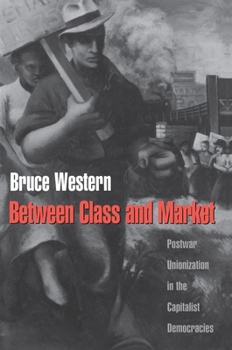
Between Class and Market: Postwar Unionization in the Capitalist Democracies


Select Format
Select Condition 
Book Overview
Revised
Format:Paperback
Language:English
ISBN:0691010331
ISBN13:9780691010335
Release Date:July 1999
Publisher:Princeton University Press
Length:256 Pages
Weight:0.79 lbs.
Dimensions:0.6" x 6.1" x 9.3"
Related Subjects
Business Business & Investing Economics Political Science Politics & Social SciencesCustomer Reviews
1 rating
Difficult and fairly obvious, but interesting and useful
Published by Thriftbooks.com User , 26 years ago
The author undertakes a highly complex statistical study of 18 OECD countries during the period from 1950 to 1989 that correlates the growth of union density with the extent of left political parties, the centralization of worker representation and bargaining, that is, union structure and function, and union-paid unemployment benefits. The main point is that it is the class power of workers as reflected in pro-worker institutions that insulates unions from market forces such as the business cycle and permits unions to grow or maintain their standing.This is not a book that makes an effort to find the historical basis of worker class power: why it exists in some places but not others. Furthermore, the reader cannot discern from this study the relative importance of class power as reflected in left political parties versus that reflected in centralized union structures and roles. Which way do the arrows of dependency point? Which comes first?The author does show that those nations that have a strong mix of pro-worker institutions have been best prepared to withstand the forces of political conservatism, large unemployment levels, and globalization that emerged in the 1980s and continue to the present day.The book is somewhat difficult and tedious to read. Its origin was for a PhD dissertation. It was assumed that the audience would have a background in advanced statistics, but there is room for the general reader. Furthermore, the book largely falls in the category of proving the obvious. At least by the 1930s it was obvious to all working classes that state and state-enabled or -permitted institutions ultimately based on workers' political power would be essential for their economic well being. Nonetheless, the book is interesting in its demonstrations of the importance of institutional power.
Copyright © 2026 Thriftbooks.com
Terms of Use | Privacy Policy | Do Not Sell/Share My Personal Information | Cookie Notice | Cookie Preferences | Accessibility Statement
ThriftBooks ® and the ThriftBooks ® logo are registered trademarks of Thrift Books Global, LLC
