


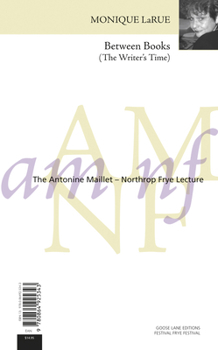
Between Books / Entre Deux Livres: The Writer's Time / Le Temps de l'Écrivain

Once a work is completed, when and how do writers and other artists embrace their next creative work? In this fascinating book, Monique LaRue gives a tantalizing glimpse of the contour of time shaped by inspiration rather than the movement of the clock. Moving from the philosophical to the personal, she provides a view of how each of her novels has come into existence -- the personal context in which each came to be and the social context in which each was received.
LaRue uses two important words in her approach to this "between-time" of creative possibility. The first, "meander," from the Greek name for Maiandros, has come to signify "wandering at random." Like Northrop Frye, she distinguishes between "Kairos," the mysterious, unpredictable moment when the creative impulse is released, and "chronos," or passing time. This ephemeral moment, as explained by LaRue, is of time but not in it. Given this paradox, it should come as no surprise that LaRue's between-time of writing creatively has no name. Mortality brings time and its passage unceasingly to mind. Yet, the mental action of moving freely through meandering associations during the time between works becomes the criterion for thinking creatively.
Une fois une oe uvre achev e, quand et comment crivains et artistes abordent-ils leur prochaine cr ation? Dans cet ouvrage passionnant, Monique LaRue nous donne un avant-go t all chant des contours du temps trac s, dans ce cas, par notre imaginaire et non par les aiguilles de l' horloge. Naviguant entre la philosophie et l' exp rience personnelle, elle nous livre un aper u de la gen se de chacun de ses livres -- tant les circonstances personnelles dans lesquelles chacun a vu le jour que le contexte social qui les a accueillis.
Deux mots cl s mergent de la d marche de LaRue dans son exploration de cet entre deux temps du potentiel cr atif. Le premier, m andre , provenant du terme grec Maiandros qui veut dire errer au hasard . l' instar de Northrop Frye, elle distingue entre Kairos , le moment myst rieux et impr visible o l' lan cr ateur est lib r , et Chronos , le temps qui passe. Pour Larue, ce moment ph m re, surgit du temps sans toutefois en faire partie. De par ce paradoxe, il n' est gu re surprenant de constater que l' entre-temps de l' criture cr ative dont traite LaRue est innomm , Notre mortalit nous renvoie inlassablement au temps. Pourtant, la pens e cr ative exige une activit mentale qui volue librement, serpentant, au cours de ce temps entre deux oe uvres, au gr des al as des associations m andres.
Customer Reviews
ThriftBooks ® and the ThriftBooks ® logo are registered trademarks of Thrift Books Global, LLC
