


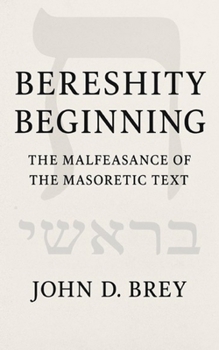
Bereshity Beginning: The Malfeasance of the Masoretic Text
No Customer Reviews

For nearly fifteen centuries, Israel carried the solemn task of preserving and interpreting the Torah given to Moses. Yet this responsibility was bound by a profound limitation: the ultimate key to the text's true meaning-the transcendental signifier-had not yet been revealed. The deepest mysteries of Torah remained veiled, awaiting Messiah, the one who alone could unveil its hidden essence. Central to this mystery were the chukkim (חוקים)-statutes without immediate rational explanation, "sign decrees" whose significance would remain obscure until Messiah appeared. Until then, Israel was to guard the Torah by living according to the mishpatim (משפטים), the judgments that could be rationally applied, and the edot (עדות), the testimonies and ordinances that bore witness to God's covenantal acts. Israel's role was thus one of stewardship and waiting-preserving the text until its Revealer disclosed its fullness. In the first century, however, this waiting was disrupted by a crisis. A Jewish firstborn arose, proclaiming himself Messiah. The nature of his claim threatened Israel's self-understanding so profoundly that its leaders made a fateful choice: they fused the oral Torah-the living tradition of Moses-with the written Torah's still-veiled meaning. By doing so, they elevated Moses as the sole interpreter of God's Word and denied the possibility that Messiah would complete what Moses merely began. . . . In retrospect, one sees why Judaism perceived the danger posed by the first-century messianic claimant. He appealed to the unresolved chukkim-those very statutes Moses left open for Messiah to reveal. By grounding his claim there, he did not rest on what was already settled, nor on anything Judaism could nail down as criminal. The chukkim themselves represented the unfinished openings preserved for Messiah. Judaism's response, however, was to seal the door Moses had left ajar. By closing the mysteries of the chukkim within Mosaic tradition, they barred not only the first-century aspirant but every future contender as well. In shutting out one, they shut out all; in rejecting what they perceived as false, they unwittingly foreclosed the true.
Format:Paperback
Language:English
ISBN:B0FNDBNQ82
ISBN13:9798299202014
Release Date:August 2025
Publisher:Independently Published
Length:110 Pages
Weight:0.26 lbs.
Dimensions:0.2" x 5.0" x 8.0"
Customer Reviews
0 rating
Copyright © 2026 Thriftbooks.com Terms of Use
| Privacy Policy | Do Not
Sell/Share My Personal Information | Cookie Policy | Cookie Preferences | Accessibility Statement
ThriftBooks® and the ThriftBooks® logo are registered trademarks of Thrift Books Global, LLC
ThriftBooks® and the ThriftBooks® logo are registered trademarks of Thrift Books Global, LLC
