


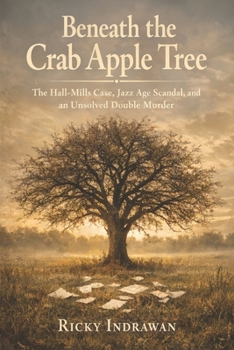
Beneath the Crab Apple Tree: The Hall-Mills Case, Jazz Age Scandal, and an Unsolved Double Murder

A quiet field outside New Brunswick. A crab apple tree. Two bodies arranged so carefully that the scene seemed to speak before the investigators ever could. Rev. Edward Wheeler Hall and Eleanor Reinhardt Mills were found side by side after vanishing into the night, their deaths already wrapped in intimacy, display, and menace. What began as a local shock became true crime history almost at once: a killing shaped by secrecy, class, religion, and public appetite.
Two victims. One staged scene. A century of unanswered consequences.
Hall was a rector moving inside status and expectation. Eleanor was a working-class wife, mother, and church singer whose humanity was too often reduced by the scandal around her death. Their relationship had become difficult to hide, but the book does not trade in lurid certainty. It returns to the surviving record with discipline, following what can be proved, weighing what was mishandled, and refusing to force a final answer where the evidence will not hold.
The bodies were discovered on September 16, 1922, near Phillips Farm off DeRussey's Lane in Franklin Township, Somerset County. Hall's calling card lay near the scene. Torn letters were scattered between the dead. Eleanor had suffered the greater brutality. The arrangement beneath the tree suggested not concealment, but intention. Was it punishment? Exposure? Control over how the story would be read? The case posed those questions immediately, then made them harder to answer by failing to protect the evidence that might have answered them.
This book follows the full arc of that unsolved double murder through the social worlds that led to it: Carman Street, Nichol Avenue, St. John's, Lake Hopatcong, the lane to Phillips Farm, and the orchard where private lives were turned into public spectacle. It tracks the affair, the widening gossip, the early jurisdictional confusion, the contaminated ground, the delayed autopsies, the missing forensic precision, the witness instability, and the reopening that transformed the case into a national courtroom storm.
At its center is a Jazz Age scandal that exposed more than desire. It exposed how class could shape suspicion, how publicity could outrun proof, and how a victim could be made secondary in her own death. It also became a lasting cold case, not because the archive is empty, but because the archive is damaged, contested, and haunted by what was lost in the first compromised hours. What did the witnesses truly see? How many people were there? What did the tableau mean? Why did the legal system stop where it did?
This book contains no images-only cinematic narrative written in the style of a detective-investigator.
Readers will move through a work of historical true crime grounded in records, testimony, chronology, and restraint. The narrative brings forward the essential through-lines of crime scene investigation, social pressure, and courtroom drama without losing sight of the two people whose deaths began it all. It offers atmosphere, but never at the expense of dignity; suspense, but never at the expense of care.
This Book Is For Readers Who...want a victim-centered account of a famous American double killingare drawn to staged crime scenes and the meanings they may concealcare about the tension between evidence, rumor, and public memoryfollow unsolved cases where the record is rich but never completewant class, religion, and reputation treated as pressures, not decorationPerfect For Fans Of...archival murder historyearly twentieth-century American crimecourtroom-centered nonfiction suspenseforensic uncertainty and damaged evidenceThe Hall-Mills murders remain unanswered, but their meaning has never stopped unfolding. Step beneath the crab apple tree and read the case with fresh eyes.
Customer Reviews
ThriftBooks ® and the ThriftBooks ® logo are registered trademarks of Thrift Books Global, LLC
