


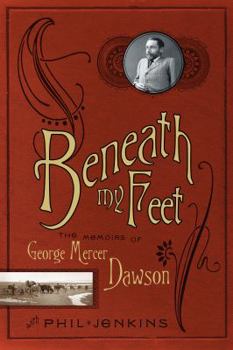
Beneath My Feet: The Memoirs of George Mercer Dawson


Select Format
Select Condition 
Book Overview
George Mercer Dawson is a towering figure in Canadian history -- and science -- as the man who led the Geological Survey during its exploration of the Canadian West, mostly from horseback or from a canoe. A tough job for anyone, it was an extraordinary achievement for Dawson. Born in 1849, Dawson was crippled by a childhood illness that left him hunchbacked and in constant pain. He never grew taller than a young boy, and he never let his disabilities stop him. An avid photographer, amateur painter, professional geologist and botanist, and by necessity an ethnographer, Dawson wrote constantly: poetry, journals, reports, notes, and more than five thousand letters, his first at the age of six and his last just two days before he died in 1901. But Dawson never wrote his memoirs. So, a century after his death, Phil Jenkins has lent him a hand. Using Dawson's own words, and filling in the gaps in Dawson's voice, Jenkins presents the man who left his heart in western Canada. Their countless stories -- from witnessing the last great buffalo stampede to encountering the timeless customs of the Haida -- evoke the real excitement of the age of exploration. Dawson knew the pain of unrequited love, suffered the bite of a million mosquitoes, and yet he travelled on, over mountainous physical odds, to become one of the most respected and enjoyed of Victorian Canadians, in the thought-provoking times of Dickens and Darwin.
Format:Hardcover
Language:English
ISBN:0771043880
ISBN13:9780771043888
Release Date:September 2007
Publisher:McClelland & Stewart
Length:368 Pages
Weight:1.50 lbs.
Dimensions:9.1" x 1.2" x 6.3"
Customer Reviews
1 rating
You can't read this and not want to follow in his tracks
Published by Thriftbooks.com User , 17 years ago
"Beneath My Feet" is a difficult book to describe. It's based on the journals, letters, and notebooks of George Mercer Dawson, one of Canada's most important scientists and the man after which Dawson City, Yukon and Dawson Creek, B.C. were named. Phil Jenkins has joined together Dawson's words into a seamless memoir. For the most part, it works very well. Dawson (as portrayed by Jenkins) describes his many adventures in 19th century Western Canada with the kind of page-turning excitement you'd expect to find in a Patrick O'Brien sea story. He describes everything from the last great buffalo run on the Prairies to canoeing down the wild Pelly River to meeting the Haida Indians of the Queen Charlotte Islands to sailing into the teeth of a violent Pacific storm with enthusiasm and joy. Part of this is that Dawson really was there: he really did descend the Chilikoot Pass at the end of a thousand-mile canoe trip through northern British Columbia and Yukon. He really did sled with his team from Edmonton to Winnipeg in the middle of a Prairie winter. He really did travel up the Fraser River years before the first road or railroad. And, in the end, after all the risk-taking and all the excitement, this indefatigable explorer really did die almost at his desk of a simple chest infection. Dawson's lively personality infuses the entire book. He writes of his mother and his sister Anna with love, expresses his impatience with his beloved father's anti-Darwinism and his religion, excoriates his brother Rankine for (as Dawson saw it) exploiting his father's memoirs for his own financial gain, and pours out his anger and resentment at the unnamed "love of his life" who abandoned him for another man. Dawson, a man of his time, never fails to note the relative attractiveness of the women he meets, but is more likely to be blunt and negative about the attractions of First Nations women, calling them "hags", "very ugly", and "hideous" at various times. One interesting point is that Dawson rarely mentions the fact that he was severely physically disabled. He was diagnosed with Pott's disease or tuberculosis of the spine, a condition that stunted his growth and gave him a prominent hunchback that must have made long treks on horseback incredibly painful. But only two or three times in the entire narrative does he refer to his disability. The only qualm I have about Beneath My Feet is that Jenkins, the compiler of Dawson's memoirs, does not show which sections are Dawson's own words and which are not. What concerns me most is the last section, which purports to give Dawson's thoughts as he lay dying. This must be fiction. It led me to wonder if anything else in the book was invented by Jenkins or if anything relevant to Dawson's personal life was left out for reasons unrelated to the course of the narrative. It's unfortunate because the book would have been just as compelling had it ended with Dawson's last diary entry in which he complains of not feeling well,
Copyright © 2025 Thriftbooks.com
Terms of Use | Privacy Policy | Do Not Sell/Share My Personal Information | Cookie Policy | Cookie Preferences | Accessibility Statement
ThriftBooks ® and the ThriftBooks ® logo are registered trademarks of Thrift Books Global, LLC
ThriftBooks ® and the ThriftBooks ® logo are registered trademarks of Thrift Books Global, LLC
