


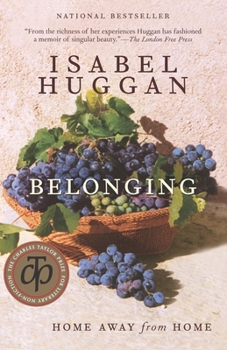
Belonging: Home Away from Home

Select Format
Select Condition 
Book Overview
Isabel Huggan's acclaimed Belonging is pure pleasure to read--richly entertaining, beautifully written, laced with gentle humour and valuable insights acquired during years of world travel. Beginning as a memoir and concluding with three short stories, Belonging illuminates the mysterious manner in which chance and choice together shape our lives. At the book's core is Isabel Huggan's stone house set among vineyards in the foothills of the C vennes mountains in the south of France, from where she contemplates the meaning of home and the importance of remembrance.
Format:Paperback
Language:English
ISBN:0676975380
ISBN13:9780676975383
Release Date:April 2004
Publisher:Vintage Books Canada
Length:352 Pages
Weight:0.75 lbs.
Dimensions:1.2" x 5.2" x 7.8"
Customer Reviews
1 rating
Learning to Belong
Published by Thriftbooks.com User , 17 years ago
Belonging is part travel book, part memoir, part reflection on the process of writing memoir. The book dives straight into all of these themes as Isabel Huggan holds the stones she once collected with her father and muses over what it means for someone to feel a sense of belonging to a specific place. After many years of travelling around the world, following her husband wherever his work takes him, Huggan tells herself that a writer can work anywhere. And so she devotes much of this book to memories of the landscapes and people she encounters in Canada, France, Kenya, the Philippines, Australia, and to the foothills of the Cevennes mountains in the south of France where her husband wishes to settle. This is the landscape that speaks to his soul. But, she wonders, what does it say to her? And what exactly does it mean to feel at home anywhere? Is it possible for her to learn to share her husband's deep attachment to this land? Huggan wrote her memoir while living in the south of France. This is the landscape against which she tries to understand her life, both as lived and as living now and into the future. Looking back over her life, she reflects on what it means to remember. Thus, when she recalls the names of her mother's old friends, a whole chain of related memories are set in motion, causing her to question the veracity and truthfulness of these distant memories. Do the memories simply tell a tale that she wants to hear? Later in the book, as she tries to assemble the bits and pieces of information and half-remembered stories about her mother, the author realizes that the more she discovers about her mother the more she learns about herself, and about the shadowy territories she prefers to avoid. Referring to both herself and her younger sister with whom she often discusses these issues, she writes, "We make up mother from dreams and scraps, working backward out of what we want to know about ourselves, about the choices we've made, and why." Huggan's reflections about her mother are perhaps the most poignant in the book, especially when she writes about how the image of her mother in a photograph looks exactly like the sort of woman she would like to spend time and share secrets with. Huggan goes on to consider how siblings recall family history differently, depending on their own personal perspective: "I am learning a great deal about recollection; there is no truth." Yet this is not necessarily a bad thing for "inconsistencies only add to the richness of mutual memory. Between us we include several, if not all, of the possibilities." As for returning to her homeland, the country in which she was born, she discovers that the act of returning is "an attempt to know oneself, just as the initial departure sprang from the same place." In the end, Huggan begins to find a way of settling into her new homeland, but it takes time--a long, slow growing into a sense of belonging. After six years of sharing an ancient stone farmhouse, gardens
Copyright © 2026 Thriftbooks.com Terms of Use
| Privacy Policy | Do Not
Sell/Share My Personal Information | Cookie Policy | Cookie Preferences | Accessibility Statement
ThriftBooks® and the ThriftBooks® logo are registered trademarks of Thrift Books Global, LLC
ThriftBooks® and the ThriftBooks® logo are registered trademarks of Thrift Books Global, LLC
