


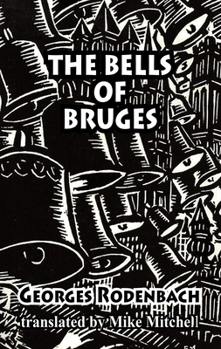
The Bells of Bruges
No Customer Reviews

The Bells of Bruges is a study of obsessive love which is steeped in the melancholy beauty of Bruges.
There are three loves in the life of Joris Borluut, the town carillonneur of Bruges. He marries the fiery Barbara, whose dark beauty is a reminder of Belgium's Spanish heritage. Repelled by her harshness and violence, he starts an affair with her sister, the gentle, soulful, fair-haired Godelieve. When her sister discovers their affair, Godelieve enters a Beguine convent and Joris devotes himself to his first love, the old city of Bruges.
'Rodenbach's contribution to the fin-de-siecle imaginary was the dead city. In poetry and in prose, in his short stories and journalism, it is the dead city - and Bruges above all - that he dramatizes and celebrates... The language question occurs in The Bells of Bruges, along with an unexpectedly wide range of other social, political and economic issues. The novel appeared in 1897, five years after Rodenbach's hugely successful Bruges-la-morte. Where Bruges-la-morte was a short, poetic psycho-drama of death and eroticism, The Bells of Bruges (given here in Mike Mitchell's nuanced but unfussy translation) is a long and crowded novel that touches on everything from nineteenth-century obsessions with progress and decline, to tourism and town planning... There are intertwined plots as there are in Bruges-la-morte. Borluut is caught between two women, the dark, fiery Barbara and the ethereal, pale Godelieve. Between them they represent, on the one hand, the earthy, Latin side of Belgian culture (Barbara is more than once referred to as a Spanish beauty, an allusion to Flander's history as a Spanish colony), and its Nordic, mystical side, Rodenbach's obsessive symmetry is such that he provides Borluut with bells that also represent this: a small, clear, tuneful bell and a large, dark bell inlaid with obscene orgiastic images, a 'bronze dress' up which he loses himself. Sex and death are never far away in Rodenbach, either from each other or from the surface of the story. As the novel's extraordinary climax shows, The Bells of Bruges, is no exception.'
Patrick McGuinness in The Times Literary Supplement
There are three loves in the life of Joris Borluut, the town carillonneur of Bruges. He marries the fiery Barbara, whose dark beauty is a reminder of Belgium's Spanish heritage. Repelled by her harshness and violence, he starts an affair with her sister, the gentle, soulful, fair-haired Godelieve. When her sister discovers their affair, Godelieve enters a Beguine convent and Joris devotes himself to his first love, the old city of Bruges.
'Rodenbach's contribution to the fin-de-siecle imaginary was the dead city. In poetry and in prose, in his short stories and journalism, it is the dead city - and Bruges above all - that he dramatizes and celebrates... The language question occurs in The Bells of Bruges, along with an unexpectedly wide range of other social, political and economic issues. The novel appeared in 1897, five years after Rodenbach's hugely successful Bruges-la-morte. Where Bruges-la-morte was a short, poetic psycho-drama of death and eroticism, The Bells of Bruges (given here in Mike Mitchell's nuanced but unfussy translation) is a long and crowded novel that touches on everything from nineteenth-century obsessions with progress and decline, to tourism and town planning... There are intertwined plots as there are in Bruges-la-morte. Borluut is caught between two women, the dark, fiery Barbara and the ethereal, pale Godelieve. Between them they represent, on the one hand, the earthy, Latin side of Belgian culture (Barbara is more than once referred to as a Spanish beauty, an allusion to Flander's history as a Spanish colony), and its Nordic, mystical side, Rodenbach's obsessive symmetry is such that he provides Borluut with bells that also represent this: a small, clear, tuneful bell and a large, dark bell inlaid with obscene orgiastic images, a 'bronze dress' up which he loses himself. Sex and death are never far away in Rodenbach, either from each other or from the surface of the story. As the novel's extraordinary climax shows, The Bells of Bruges, is no exception.'
Patrick McGuinness in The Times Literary Supplement
Format:Paperback
Language:English
ISBN:1915568331
ISBN13:9781915568335
Release Date:June 2026
Publisher:Dedalus
Length:244 Pages
Weight:0.50 lbs.
Dimensions:0.8" x 5.2" x 7.8"
Customer Reviews
0 rating
Copyright © 2026 Thriftbooks.com
Terms of Use | Privacy Policy | Do Not Sell/Share My Personal Information | Cookie Notice | Cookie Preferences | Accessibility Statement
ThriftBooks ® and the ThriftBooks ® logo are registered trademarks of Thrift Books Global, LLC
ThriftBooks ® and the ThriftBooks ® logo are registered trademarks of Thrift Books Global, LLC
