


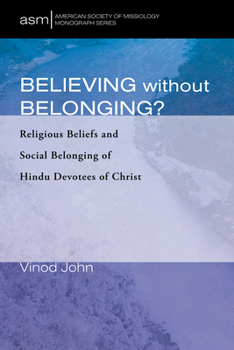
Believing Without Belonging?: Religious Beliefs and Social Belonging of Hindu Devotees of Christ
No Customer Reviews

This study examines an indigenous phenomenon of the Hindu devotees of Jesus Christ and their response to the gospel through an empirical case study conducted in Varanasi, India. It analyzes their religious beliefs and social belonging and addresses the ensuing questions from a historical, theological, and missiological perspective. The data reveals that the respondents profess faith in Jesus Christ; however, most remain unbaptized and insist on their Hindu identity. Hence, a heuristic model for a contextualized baptism as Guru-diksha is proposed. The emergent church among Hindu devotees should be considered, from the perspective of world Christianity, as a disparate form of belonging while remaining within one's community of birth. The insistence on a visible church and a distinct community of Christ's followers is contested because the devotees should construct their contextual ecclesiology, since it is an indigenous discovery of the Christian faith. Thus, the "Christian" label for the adherents is dispensable while retaining their socio-ethnic Hindu identity. Christian mission should discontinue extraction and assimilation; instead, missional praxis should be within the given sociocultural structures, recognizing their idiosyncrasies as legitimate in God's eyes and in need of transformation, like any human culture.
Format:Hardcover
Language:English
ISBN:1532697236
ISBN13:9781532697234
Release Date:November 2020
Publisher:Pickwick Publications
Length:250 Pages
Weight:1.14 lbs.
Dimensions:0.6" x 6.0" x 9.0"
Customer Reviews
0 rating
Copyright © 2026 Thriftbooks.com Terms of Use
| Privacy Policy | Do Not
Sell/Share My Personal Information | Cookie Policy | Cookie Preferences | Accessibility Statement
ThriftBooks® and the ThriftBooks® logo are registered trademarks of Thrift Books Global, LLC
ThriftBooks® and the ThriftBooks® logo are registered trademarks of Thrift Books Global, LLC
