
Skip to content
Scan a barcode
Scan
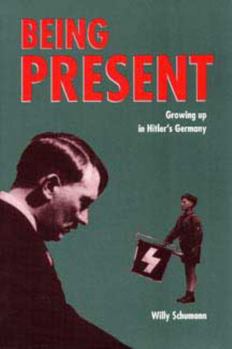
Paperback Being Present: Growing Up in Hitler's Germany Book

ISBN: 0873384938

ISBN13: 9780873384933

Being Present: Growing Up in Hitler's Germany

Select Format

Select Condition ThriftBooks Help Icon

Recommended

Format: Paperback

Condition: Very Good

$8.69
Save $9.31!
List Price $18.00
Almost Gone, Only 2 Left!
Save to List

Book Overview

Willy Schumann's chronicle of the years 1930 to 1950 gives an eye- and ear-witness account of what it was like to grow up in Germany during the Third Reich. His generation of Germans, born in the 1920s, was shaped in an atmosphere of all-encompassing mind control in a one-party state.

Schumann provides many anecdotes based on his experiences in elementary school and the Gymnasium, Hitler Youth groups, premilitary training camps and, finally, military service. They serve to illustrate the accompanying factual, historical material of how nazism both succeeded and failed in winning the minds of German youth, the attitudes of the young toward the National Socialist party, and why acceptance of military defeat was nearly impossible until Hitler's death.

The reeducation of the Hitler Youth during the postwar years of 1945 to 1950 came slowly. Schumann explains the difficulties they encountered in their adjustment to the Allied occupation and their struggles to accept the fact that they had served such a cruel regime. He also shows the ultimate success of the process to intergrate these by-then young adults into the free and open society of the Federal Republic of Germany.

Customer Reviews

4 ratings

Find out what Germany was really like for the average person

This is a very well written book, easy to read with many interesting personal stories. The Author does a great job of explaining what it was like for the average person living in Germany at the time. As the byline suggests, this book chonicles what life was like for a school age kid growing up in Hiter's Germany. Autor provides geat insight into the life of children in the Hitler Youth. The latter parts of the book decribe what Germany was like during the war, it does not go over every battle, but he does mention the larger scale operations. This books strength lies in the Author's ability to humanize the German people at a time when gross crimes against humanity were being committed, unbeknownst to most, at the higher levels. I highly recomend this to anyone interested in WWII history.

A Story Of A State In Control

"Being Present" by Willy Schumann. Subtitled: "Growing Up In Hitler's Germany" Kent State University, Kent, Ohio. 1991. In 1927, Willy Schumann was born in northern Germany, up by the Kiel Canal and the border with Denmark. Due to this location, Willy Schumann, the author of this autobiographic book, had a great interest in the German Navy, (the Kriegsmarine), German warships and seamanship. His father was one of the pilots whose job was to guide large vessels through the Kiel Canal and its locks. The book is an account of how the Nazi Party took over all facets of life in the Third Reich, but most interestingly, it is an account of how the Nazi Party ran almost every aspect of the education system: teachers, curriculum and even the students' expected responses. At an early age, each German boy was required to join the Hitler Youth Hitler Youth compulsory participation (see page 104) took up more and more of a boy's time, as he grew older and older, until, for teenagers, the organization consumed even summer vacations with war games. Willy Schumann recounts his experiences in the Hitler Youth, his indoctrination by Nazi concepts, and his belief in the Third Reich, reinforced, in 1939 through 1940, as the German army won victory after victory. He tells of the joy as the conquests of Poland, Norway, Denmark, and so on, are reported to the German people. In the early years, the only setback that he recalls is the sorrow with the sinking of the Bismark, their "darling ship", by the Royal Navy. The Nazi Party held close control over the German people. Schumann records that the teachers found it wise not to disagree with Nazi propaganda. Religion was ignored in favor of Nazi events, so "...we grew up `like small heathens'". (Page 81.) No one dared to speak out against Adolf Hitler and his actions, and this really became dangerous after the July 20 1944 assassination attempt on Hitler. I could go on, but you ought to read his book yourself to get one man's story of a society that, at first, was grateful for better economic conditions but then became more and more fearful as the Nazis took more and more control. To sum up, this is one man's study of how the State consumed every aspect of life until the State, itself, was consumed by outside forces. Schumann tells of his trip through the ruins of the city of Hamburg, which had been consumed by a firestorm, (July 1943), caused by RAF bombing.

One of the better WW II memoirs out there

There's no shortage of memoirs out there written by German veterans of WW II, but only a few of them shed much light on what life was like in Germany during the war. This is one such book, and does a very good job of describing how the war affected ordinary Germans. Since the author was too young to participate in the fighting, this is not a helpful book if you want to learn about life as a front-line infantryman, but this book does add one more interesting piece to the puzzle. For readers who want to obtain a broad understanding of Germany during WW II, this is definitely a book worth reading.

Gives you a different impression of what life was like..

This is a good, balanced version of events that took place in Nazi Germany. Willy Schumann writes about his own experience as a young German boy living at the time. I read the book for a research paper on the youth experience in Nazi Germany and what made this book stand out was that it did not take an extreme stand-point. The author was a Hitler youth member but he seems, even under the effects of indoctrination, to be able to do some thinking on his own -- he did not oppose the regime but he was not a rabid follower of the Hitler youth either. The book continues after the war and gives us a good insight into the plight of the Germans after the war. The book reads like a novel (which is not always the case in history books) and the author is smart and witty -- above all he is human.
Copyright © 2026 Thriftbooks.com Terms of Use | Privacy Policy | Do Not Sell/Share My Personal Information | Cookie Policy | Cookie Preferences | Accessibility Statement
ThriftBooks® and the ThriftBooks® logo are registered trademarks of Thrift Books Global, LLC

GoDaddy Verified and Secured