


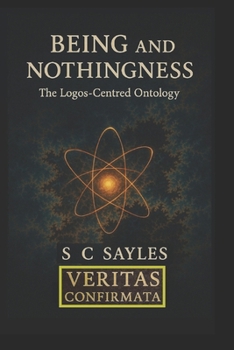
Being and Nothingness: The Logos-Centred Ontology
No Customer Reviews

Ontology as Theological Ground
This book is part of the philosophy series "VERITAS CONFIRMATA"
Which uses a propositional framework based upon the "Tractatus Logico-Philosophicus"
This book presents a unified vision in which the nature of reality, the meaning of existence, and the destiny of creation are brought into focus through the person and work of the Logos-The book is structured as a progression of assertive propositions in the style of Wittgenstein's Tractatus, each developed with theological precision, philosophical rigour, and a deep commitment to the Logos-centric truth. At its core, the work affirms that God is not merely a being among other beings, but Being itself-the self-existent One who gives being to all that exists. This foundational truth becomes the interpretive key for every other discussion in the book. The Logos, as the eternal Word of God, is revealed as the ground of ontology, the origin of information, and the source of all coherence in creation
Ontology as Theological Ground The opening propositions dismantle materialist and autonomous human philosophies by asserting that reality is fundamentally informational rather than material-an ordered field upheld by the mind and will of God. Against secular metaphysics, the book insists that ontology cannot be understood apart from theology, for the question of being is inseparable from the God who is.
Here, the work draws on Scripture, the Church Fathers, and Reformed theologians to demonstrate that creation does not have being in itself, but participates in being only by God's sustaining act. Augustine's distinction between the Creator and the creature frames the discussion, and Calvin's doctrine of providence undergirds the insistence that there is no independent existence. Evil as Ontological Parasite
A unique contribution of this volume is its treatment of evil as an ontological parasite. Evil has no independent being-it is not a positive force but a privation, a corruption of what is good. Drawing from Augustine and further developed in the Reformed tradition, the book shows that evil's nature is parasitic: it feeds on God's good creation, distorting and disordering, but can never create.
This framing gives a decisive theological answer to the problem of evil. Sin is portrayed not merely as moral rebellion, but as anti-being, anti-creation, and anti-truth-opposed to the ontological structure upheld by the Logos. The Antithesis and Epistemic Conflict
The work draws heavily on Cornelius Van Til's doctrine of the antithesis-the absolute opposition between belief and unbelief. All human interpretation of reality is either grounded in the Logos or in rebellion against Him. Neutrality is a myth. This section examines the interpretive conflict between the Christian worldview and secular ontologies, showing that only the Logos provides a coherent account of reality. The Teleology of Creation
The cosmos is teleological: every atom, every law, every living soul exists for the glory of the Logos. The book builds a theological vision of the end (telos) of all things-the transformation of the cosmos into a dwelling of righteousness. History is not a meaningless cycle but a linear movement toward consummation in Christ.
Here, the Logos is not only the Alpha but also the Omega, the One in whom creation's purpose is fulfilled. The narrative sweeps from Genesis to Revelation, showing the unbroken line of divine intention. The book is a call to intellectual and spiritual reformation-an invitation to reject false ontologies and embrace the truth that God Himself is Being, and all creation exists only in Him.
This book is part of the philosophy series "VERITAS CONFIRMATA"
Which uses a propositional framework based upon the "Tractatus Logico-Philosophicus"
This book presents a unified vision in which the nature of reality, the meaning of existence, and the destiny of creation are brought into focus through the person and work of the Logos-The book is structured as a progression of assertive propositions in the style of Wittgenstein's Tractatus, each developed with theological precision, philosophical rigour, and a deep commitment to the Logos-centric truth. At its core, the work affirms that God is not merely a being among other beings, but Being itself-the self-existent One who gives being to all that exists. This foundational truth becomes the interpretive key for every other discussion in the book. The Logos, as the eternal Word of God, is revealed as the ground of ontology, the origin of information, and the source of all coherence in creation
Ontology as Theological Ground The opening propositions dismantle materialist and autonomous human philosophies by asserting that reality is fundamentally informational rather than material-an ordered field upheld by the mind and will of God. Against secular metaphysics, the book insists that ontology cannot be understood apart from theology, for the question of being is inseparable from the God who is.
Here, the work draws on Scripture, the Church Fathers, and Reformed theologians to demonstrate that creation does not have being in itself, but participates in being only by God's sustaining act. Augustine's distinction between the Creator and the creature frames the discussion, and Calvin's doctrine of providence undergirds the insistence that there is no independent existence. Evil as Ontological Parasite
A unique contribution of this volume is its treatment of evil as an ontological parasite. Evil has no independent being-it is not a positive force but a privation, a corruption of what is good. Drawing from Augustine and further developed in the Reformed tradition, the book shows that evil's nature is parasitic: it feeds on God's good creation, distorting and disordering, but can never create.
This framing gives a decisive theological answer to the problem of evil. Sin is portrayed not merely as moral rebellion, but as anti-being, anti-creation, and anti-truth-opposed to the ontological structure upheld by the Logos. The Antithesis and Epistemic Conflict
The work draws heavily on Cornelius Van Til's doctrine of the antithesis-the absolute opposition between belief and unbelief. All human interpretation of reality is either grounded in the Logos or in rebellion against Him. Neutrality is a myth. This section examines the interpretive conflict between the Christian worldview and secular ontologies, showing that only the Logos provides a coherent account of reality. The Teleology of Creation
The cosmos is teleological: every atom, every law, every living soul exists for the glory of the Logos. The book builds a theological vision of the end (telos) of all things-the transformation of the cosmos into a dwelling of righteousness. History is not a meaningless cycle but a linear movement toward consummation in Christ.
Here, the Logos is not only the Alpha but also the Omega, the One in whom creation's purpose is fulfilled. The narrative sweeps from Genesis to Revelation, showing the unbroken line of divine intention. The book is a call to intellectual and spiritual reformation-an invitation to reject false ontologies and embrace the truth that God Himself is Being, and all creation exists only in Him.
Format:Paperback
Language:English
ISBN:B0FML8FGHT
ISBN13:9798298258135
Release Date:August 2025
Publisher:Independently Published
Length:262 Pages
Weight:0.78 lbs.
Dimensions:0.6" x 6.0" x 9.0"
Related Subjects
PhilosophyCustomer Reviews
0 rating
Copyright © 2026 Thriftbooks.com
Terms of Use | Privacy Policy | Do Not Sell/Share My Personal Information | Cookie Policy | Cookie Preferences | Accessibility Statement
ThriftBooks ® and the ThriftBooks ® logo are registered trademarks of Thrift Books Global, LLC
ThriftBooks ® and the ThriftBooks ® logo are registered trademarks of Thrift Books Global, LLC
