
Skip to content
Scan a barcode
Scan
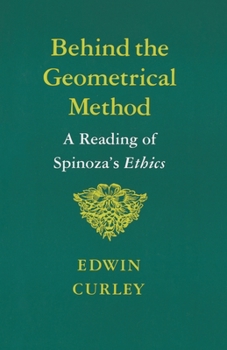
Paperback Behind the Geometrical Method: A Reading of Spinoza's Ethics Book

ISBN: 069102037X

ISBN13: 9780691020372

Behind the Geometrical Method: A Reading of Spinoza's Ethics

Select Format

Select Condition ThriftBooks Help Icon

Recommended

Format: Paperback

Condition: New

$41.00
50 Available
Ships within 2-3 days

Book Overview

This book is the fruit of twenty-five years of study of Spinoza by the editor and translator of a new and widely acclaimed edition of Spinoza's collected works. Based on three lectures delivered at the Hebrew University of Jerusalem in 1984, the work provides a useful focal point for continued discussion of the relationship between Descartes and Spinoza, while also serving as a readable and relatively brief but substantial introduction to the Ethics for students. Behind the Geometrical Method is actually two books in one. The first is Edwin Curley's text, which explains Spinoza's masterwork to readers who have little background in philosophy. This text will prove a boon to those who have tried to read the Ethics, but have been baffled by the geometrical style in which it is written. Here Professor Curley undertakes to show how the central claims of the Ethics arose out of critical reflection on the philosophies of Spinoza's two great predecessors, Descartes and Hobbes.

The second book, whose argument is conducted in the notes to the text, attempts to support further the often controversial interpretations offered in the text and to carry on a dialogue with recent commentators on Spinoza. The author aligns himself with those who interpret Spinoza naturalistically and materialistically.

Customer Reviews

1 rating

It's two books in one!

I don't ordinarily like books that devote too much space to endnotes. For one thing, I hate having to flip to the back of the book to read the blinkin' things. For another, it just seems as though, if you have something important to say, you ought to be able to work it into your text.But Edwin Curley's _Behind the Geomtrical Method_ is an exception. He's got his main text, and he's got his notes, and the notes are thirty pages long and filled with the sort of stuff you'd expect thirty pages of notes to be filled with. But he has excellent reasons for dividing his text as he does, and it actually works pretty well.You see, what he wants to do on the one hand is provide a fairly accessible introduction to Spinoza's _Ethics_. That's not easy to do if you have to burden your text (and your reader) with lots and lots of technical philosophical argumentation. Plus he's developed his views a bit since 1969 (when he published _Spinoza's Metaphysics_) and he wants to update his own outlook.But he needs _somewhere_ to put the technical argumentation, because his _other_ purpose is to disagree with practically every word Jonathan Bennett has written on this subject. Bennett is the author of the absolutely brilliant _A Study of Spinoza's Ethics_, a book of the very finest caliber that subjects Spinoza to the sort of close reading every philosopher should receive at least once. But there are problems with his account, and Curley (who also thinks highly of Bennett) wants to correct them.Well, for the purposes of this review, we'll leave the two Spinoza scholars to their disagreement (which has essentially to do with how Spinoza thought modes were related to substances). But the reader who wants to see a philosophical debate conducted with panache and chivalry (not to mention wit) will enjoy following up on this exchange. (See _The Cambridge Companion to Spinoza_, edited by Don Garrett, for some more of it; further references are in its bibliography. And don't miss Richard Mason's _The God of Spinoza_ for a third point of view.)At bottom what Curley wants to do is something Harry Austryn Wolfson attempted with not altogether satisfactory results, and Bennett doesn't even pretend to try: locate Spinoza in philosophical history, and make sense of his philosophy by understanding in context who and what he was responding to. (What two names belong on the shortlist? If you guessed Descartes and Hobbes, give yourself an A.) He does a nice job of this even though I have to disagree with some of his own interpretations of Spinoza. (He reads Spinoza as a naturalistic materialist.)It's a nice commentary, and it's a good companion for a trek through the _Ethics_. If you're looking for such a thing, I'd probably recommend starting with Genevieve Lloyd's _Spinoza and the Ethics_, but don't forget to come back to this one.
Copyright © 2026 Thriftbooks.com Terms of Use | Privacy Policy | Do Not Sell/Share My Personal Information | Cookie Policy | Cookie Preferences | Accessibility Statement
ThriftBooks® and the ThriftBooks® logo are registered trademarks of Thrift Books Global, LLC

GoDaddy Verified and Secured