


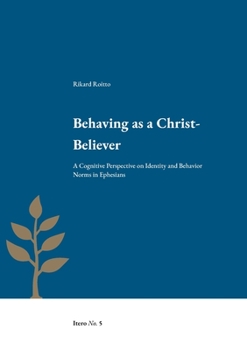
Behaving as a Christ-Believer: A Cognitive Perspective on Identity and Behavior Norms in Ephesians
No Customer Reviews

This study contributes to the understanding of how first century Christ-believers, particularly those who shared the imagination of Ephesians, experienced the relation between their social identity as Christ-believers and behavior norms. In order to understand this, a number of theories from the cognitive sciences are used in combination with historical-critical methods. After a theoretical survey of relevant cognitive theories and discussions about the epistemological problems of using cognitive theories on historical texts, the theories are used to understand (a) how Ephesians imagines the relation between identity and behavior norms and (b) the potential group dynamic effects of this imagination. The result is a demonstration of how Ephesians is able to create a coherent narrative, beginning with God's agency and ending with behavior (norms), and facilitating psychological and group dynamic effects such as intergroup distinction, self-esteem, cognitive certainty and consensus among group members, intragroup cooperation, moral judgment and inclusion/marginalization, motivation to remain committed and, last but not least, a sense of capacity and obligation to act morally.
Format:Paperback
Language:English
ISBN:9188906175
ISBN13:9789188906175
Release Date:December 2021
Publisher:Enskilda Hogskolan Stockholm
Length:368 Pages
Weight:0.97 lbs.
Dimensions:0.8" x 5.8" x 8.3"
Customer Reviews
0 rating
Copyright © 2026 Thriftbooks.com
Terms of Use | Privacy Policy | Do Not Sell/Share My Personal Information | Cookie Policy | Cookie Preferences | Accessibility Statement
ThriftBooks ® and the ThriftBooks ® logo are registered trademarks of Thrift Books Global, LLC
ThriftBooks ® and the ThriftBooks ® logo are registered trademarks of Thrift Books Global, LLC
