


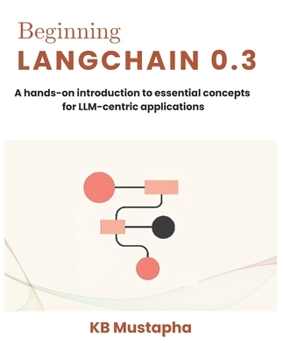
Beginning LangChain 0.3: A hands-on introduction to essential concepts for LLM-centric applications
No Customer Reviews

Beginning LangChain 0.3 provides a methodical, hands-on introduction to the core packages within LangChain, key classes within the modules of these packages, and important class-specific parameters in these modules. The book emphasises problem-solving strategies. With each chapter infused with a carefully laid-out scaffolding introduction to build intuition about LangChain concepts and thoughtfully arranged code recipes demonstrating applications, this book will help you get to grips with the core components of LangChain for building GenAI applications. Four reasons to learn LangChain: Streamlined development of GenAI applications: Built atop critical Python packages, LangChain streamlines the creation of GenAI applications by unifying access to an otherwise fragmented ecosystem of tools.Programmatic control over LLM output: LangChain layers programmatic control over LLM responses, making it easy to tame unpredictability, enforce structure, and align outputs with task-specific requirements.Support for systems thinking: It incentivizes the development of LLM-based applications around systems thinking by encouraging the creation of distinct and modular components.End-to-end ecosystem: The LangChain ecosystem offers a unified interface to essential accessories, ranging from tracing and monitoring to deployment that supports the full development lifecycle of LLM-focused applications.Why learn LangChain from this book?
This book provides a methodical, hands-on introduction to the core packages within LangChain, key classes within the modules of these packages, and important class-specific parameters in these modules. The book emphasises problem-solving strategies. With each chapter infused with a carefully laid-out scaffolding introduction to build intuition about LangChain concepts and thoughtfully arranged code recipes demonstrating applications, this book will help you get to grips with the core components of LangChain for building GenAI applications. What to expect: Discover how to harness LangChain's prompt template, few-shot template, and chat prompt template to inject prompt engineering techniques into your application logic.Experiment with runnables and understand how to leverage them to implement input routing schemes and LLM evaluator workflowGain clarity on how to build a lightweight multi-source RAG workflow that incorporates document processing, vector search, embedding model, and third-party vector stores. Learn how to evaluate RAG and how to use evaluation metrics to identify the inadequacy of a RAG pipeline to drive its improvement.Understand how to move beyond leaning on LangChain's off-the-shelf evaluator to more advanced evaluation packages, such as DeepEval, in the evaluation procedureWork with LangChain's specialized functionalities for interfacing with OpenAI GPT models and HF modelsUnique features: LangChain 0.3 - Presents workable code recipes built using the latest LangChain release (v0.3)References - Contains chapters supported by copious references to useful technical blogs and relevant academic articles for further reading and exploration.Code Repo - Augments with a companion repository for keeping code examples current.Who this book is for:
This book is for beginners seeking a friendly, code-focused introduction to LangChain. This comprises students, aspiring generative AI engineers, ML engineers, and users interested in crafting generative AI products with LangChain. In style, the book favors practical examples over theory. It is a compendium of recipes that help you build intuition through practical codes.
This book provides a methodical, hands-on introduction to the core packages within LangChain, key classes within the modules of these packages, and important class-specific parameters in these modules. The book emphasises problem-solving strategies. With each chapter infused with a carefully laid-out scaffolding introduction to build intuition about LangChain concepts and thoughtfully arranged code recipes demonstrating applications, this book will help you get to grips with the core components of LangChain for building GenAI applications. What to expect: Discover how to harness LangChain's prompt template, few-shot template, and chat prompt template to inject prompt engineering techniques into your application logic.Experiment with runnables and understand how to leverage them to implement input routing schemes and LLM evaluator workflowGain clarity on how to build a lightweight multi-source RAG workflow that incorporates document processing, vector search, embedding model, and third-party vector stores. Learn how to evaluate RAG and how to use evaluation metrics to identify the inadequacy of a RAG pipeline to drive its improvement.Understand how to move beyond leaning on LangChain's off-the-shelf evaluator to more advanced evaluation packages, such as DeepEval, in the evaluation procedureWork with LangChain's specialized functionalities for interfacing with OpenAI GPT models and HF modelsUnique features: LangChain 0.3 - Presents workable code recipes built using the latest LangChain release (v0.3)References - Contains chapters supported by copious references to useful technical blogs and relevant academic articles for further reading and exploration.Code Repo - Augments with a companion repository for keeping code examples current.Who this book is for:
This book is for beginners seeking a friendly, code-focused introduction to LangChain. This comprises students, aspiring generative AI engineers, ML engineers, and users interested in crafting generative AI products with LangChain. In style, the book favors practical examples over theory. It is a compendium of recipes that help you build intuition through practical codes.
Format:Paperback
Language:English
ISBN:B0FK218H1L
ISBN13:9798293930616
Release Date:July 2025
Publisher:Independently Published
Length:190 Pages
Weight:0.74 lbs.
Dimensions:0.4" x 7.5" x 9.3"
Customer Reviews
0 rating
Copyright © 2026 Thriftbooks.com
Terms of Use | Privacy Policy | Do Not Sell/Share My Personal Information | Cookie Policy | Cookie Preferences | Accessibility Statement
ThriftBooks ® and the ThriftBooks ® logo are registered trademarks of Thrift Books Global, LLC
ThriftBooks ® and the ThriftBooks ® logo are registered trademarks of Thrift Books Global, LLC
