


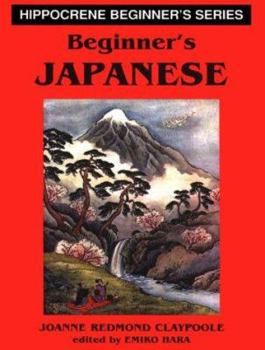
Beginner's Japanese

Select Format
Select Condition 
Book Overview
The Beginner's Series consists of basic foreign language instruction, which includes vocabulary, grammar, and common phrases. Review questions and exercises strengthen the student's knowledge and... This description may be from another edition of this product.
Format:Paperback
Language:English
ISBN:0781802342
ISBN13:9780781802345
Release Date:January 1
Publisher:Hippocrene Books, Incorporated
Length:290 Pages
Weight:0.85 lbs.
Dimensions:0.7" x 6.0" x 8.0"
Customer Reviews
5 ratings
Japanese book
Published by Thriftbooks.com User , 16 years ago
I love this book i brought it with me on the way to japan very helpful this book proves itself!
One Of The Best Around
Published by Thriftbooks.com User , 20 years ago
This has been, for me on my long quest to speak the Japanese Language(or, in Japanese, Nihongo), a tool of immeasurable value. Each lesson begins with a dialogue in hiragana and katakana(dont worry guys, they give you a chart for both in the front and then go into pronunciation and all that stuff for each!)and then the same dialogue with Japanese on the right side in the roman alphabet(romaji) and then in full English to the left. On the right of the right page, they have cultural notes, notes on words or ideas, and detailed grammar bits. On the left of the left, they have vocabulary. After that, she explains the grammar we will learn in that lesson, and then goes into some grammar bits. After that, there are the exercises, and then a self quiz. Answers are in the back, right next to the Japanese-English, English-Japanese Dictionary!!! This book covers from going from area to area to going to the doctor. There is a little annoyance of mine that this doesnt go much into the particle aspect of it, but I still think this deserves a five and more. The writer herself is not a native speaker(although it was revised by one), so she knows where we are coming from! And the cultural notes are an interesting and fun addition to the book! I highly recommend this book, and I am going to look at Hippocrene books for the other languages Im learning!!!
Excellent beginner's book
Published by Thriftbooks.com User , 22 years ago
I think this is one of the better Hippocrene Beginner's Series books I've seen. It would be suitable for a good introduction to Japanese for most people. It's laid out differently from most of the Hippocrene Beginner's books I've seen. The right-hand margin of the right page has sidebars that elaborate on or add to the text, such as discussing aspects of Japanese culture, or fine points of the grammar. The left-hand margin of the left page has the current chapter's vocabulary list and definitions. The author makes a very interesting statement, which is that it takes a Japanese speaker 5 to 8 years to achieve fluency in English, but an English speaker only 2 to 3 years for Japanese. I don't know if this is true or not, but one major thing Japanese has going for it is the very regular verbs and other aspects of the grammar. Unlike English, Spanish, French, and other Indo-European languages, which often have hundreds of irregular verbs, Japanese only has two. For example, 22 of the most commmon Spanish verbs are irregular in the present indicative tense, and of those, 18 are irregular in the subjunctive mood and often several other conjugations, making for a great deal of memory work.The main difficulty for most English speakers will be that some concepts in Japanese will seem strange. For example, Japanese doesn't have adjectives as we know it. They actually belong to the verb rather than the noun grammatically, and are are conjugated to agree with the verb rather than declined to agree with nouns, as in most languages. And even verbs don't exist as we know them. In Japanese, it's most accurate to think of verbs as expressing the "act of doing something," rather than simple action per se, according to another book on Japanese I just read.The book is also good for discussing basic Japanese sentence patterns, and these are often highlighted and discussed in the text. However, the book doesn't really go into Japanese particles in depth, which are a more advanced and difficult part of the grammar, but I wouldn't expect that in a beginning book. These are small standalone words that serve various functions, such as marking the subject, topic, or modifying the verb, and other things. For that you'll need a more advanced book. There are at least two books out I've seen devoted just to particles. These are: "Dictionary of Japanese Particles," by Sue Kawashima, and the other is "All About Particles," by Naoko Chino. Both of these are excellent and will help you with this important area of the grammar. Another good book is "Japanese Sentence Patterns," which discusses 50 basic patterns and 69 variations, also by Naoko Chino. But getting back to the present book, there are 25 lessons or chapters. Each lesson has exercises, self-tests, a vocabulary list, and discussions of grammar. The grammatical discussions aren't too technical but cover the necessary points well. The book also includes an index with all the vocabulary words paged to the text, and a discuss
One of the BEST books for Beginners
Published by Thriftbooks.com User , 23 years ago
I recommend this book to anyone who has no clue about japanese. It is one of the easy to read and understand books for beginners. I recommend that before you start the lesson that you learn hiragana and katakana first so that you pronounce the words correctly. This book offers clear, concise phrases that will help you learn japanese very quickly. I love this book. It's a starting point to learning japanese. I picked up japanese very quickly with this book and has continued onto intermediate japanese. Anybody can be fluent in japanse in just 2 years or under. I started with this book a year and a half ago and have enjoyed it very much. It helped me so much.
Just the approach I wanted
Published by Thriftbooks.com User , 27 years ago
I was looking for a book that would explain the structure of Japanese sentences and not just have me parrot phrases, and this book does it. It starts out with a quick guide to pronunciation and Hiragana and Katakana characters and then begins on the lessons. Each lesson opens with a dialogue written in both Hiragana and Ramaji which contains new words, and then goes on to explain the gramar of the sentences in the conversation. Vocabulary is defined along the borders of each page in the lesson. After the gramar section a series of exercises are presented which ask you to make new sentences, give you additional vocabulary, and have you replace words in a given sentence. Each lesson builds on the previous ones. If it came with some cassette tapes and maybe some help on writing Hiragana and Katakana it would be perfect.
Copyright © 2026 Thriftbooks.com
Terms of Use | Privacy Policy | Do Not Sell/Share My Personal Information | Cookie Policy | Cookie Preferences | Accessibility Statement
ThriftBooks ® and the ThriftBooks ® logo are registered trademarks of Thrift Books Global, LLC
ThriftBooks ® and the ThriftBooks ® logo are registered trademarks of Thrift Books Global, LLC
