


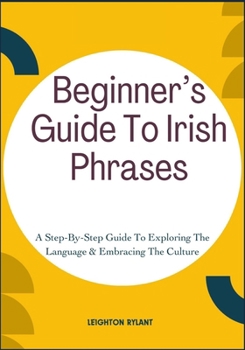
Beginner's Guide To Irish Phrases: A Step-By-Step Guide To Exploring The Language & Embracing The Culture
No Customer Reviews

Scottish Gaelic and Manx are both Celtic languages that belong to the Goidelic branch, which includes the Irish language, Gaeilge (pronounced "Gwal-guh"). It is one of the official languages of Ireland, where it is the national and first official language, despite the fact that English is more extensively spoken.
- Historical Background: Irish is an ancient language with roots tracing back to the Celts, who arrived in Ireland around 500 BC. The language evolved through several stages: Old Irish (600-900 AD), Middle Irish (900-1200 AD), and Early Modern Irish (1200-1600 AD). In the 17th and 18th centuries, however, the language faced significant decline, especially due to English colonization and suppression of the language. The language revival movement in the 19th and 20th centuries helped secure its place in contemporary Irish society.
- Geographical Distribution: While Irish is not as widely spoken as it once was, there are still areas in Ireland, especially in the Gaeltacht (Irish-speaking regions), where the language is spoken daily. The Gaeltacht regions are primarily located along the western coast, including counties like Galway, Kerry, and Donegal. Irish is also spoken in some communities abroad, particularly in places with Irish heritage like the United States, Canada, and Australia.
- Language Status: Today, Irish is taught in schools across Ireland, and there are efforts to revive and preserve it. However, its use in daily conversation is limited, with most speakers using English in most contexts. Despite this, Irish holds cultural significance, and there is a growing movement to promote the language in the media, arts, and government.
Key Characteristics of Irish:
- Pronunciation: Irish pronunciation can be tricky for learners due to its use of broad and slender consonants. The broad consonants are articulated with the tongue toward the back of the mouth, while the slender consonants are articulated with the tongue near the front.
- Vowels: The vowel system is relatively complex with a distinction between long and short vowels.
- Grammatical Structure: Irish follows a Verb-Subject-Object (VSO) word order, which is different from English's Subject-Verb-Object (SVO) structure.
- Cases: Irish uses a system of grammatical cases, including nominative, genitive, and dative cases, which affect nouns, adjectives, and articles.
- Mutation: Irish features initial consonant mutations, where the first letter of a word changes depending on the grammatical context, such as after prepositions or certain adjectives.
- Learning the Language: If you're interested in learning Irish, starting with basic phrases, greetings, and pronunciation is key. Language courses, apps, and books are available for beginners. Listening to Irish music, radio, or watching TV shows or movies can also help you get used to the rhythm and sounds of the language. The process of learning can be challenging, but it is also highly rewarding for those interested in Irish culture and history.
- Cultural Importance: The Irish language is deeply tied to the culture, literature, and identity of Ireland. It has produced a wealth of traditional songs, poems, and stories, many of which are passed down orally. Understanding Irish offers a deeper connection to Ireland's heritage and an appreciation of its rich literary tradition.
While the Irish language faces challenges, it remains a vital part of the country's culture and identity. With ongoing efforts to revitalize the language, Irish continues to be a unique and valuable linguistic treasure.
- Historical Background: Irish is an ancient language with roots tracing back to the Celts, who arrived in Ireland around 500 BC. The language evolved through several stages: Old Irish (600-900 AD), Middle Irish (900-1200 AD), and Early Modern Irish (1200-1600 AD). In the 17th and 18th centuries, however, the language faced significant decline, especially due to English colonization and suppression of the language. The language revival movement in the 19th and 20th centuries helped secure its place in contemporary Irish society.
- Geographical Distribution: While Irish is not as widely spoken as it once was, there are still areas in Ireland, especially in the Gaeltacht (Irish-speaking regions), where the language is spoken daily. The Gaeltacht regions are primarily located along the western coast, including counties like Galway, Kerry, and Donegal. Irish is also spoken in some communities abroad, particularly in places with Irish heritage like the United States, Canada, and Australia.
- Language Status: Today, Irish is taught in schools across Ireland, and there are efforts to revive and preserve it. However, its use in daily conversation is limited, with most speakers using English in most contexts. Despite this, Irish holds cultural significance, and there is a growing movement to promote the language in the media, arts, and government.
Key Characteristics of Irish:
- Pronunciation: Irish pronunciation can be tricky for learners due to its use of broad and slender consonants. The broad consonants are articulated with the tongue toward the back of the mouth, while the slender consonants are articulated with the tongue near the front.
- Vowels: The vowel system is relatively complex with a distinction between long and short vowels.
- Grammatical Structure: Irish follows a Verb-Subject-Object (VSO) word order, which is different from English's Subject-Verb-Object (SVO) structure.
- Cases: Irish uses a system of grammatical cases, including nominative, genitive, and dative cases, which affect nouns, adjectives, and articles.
- Mutation: Irish features initial consonant mutations, where the first letter of a word changes depending on the grammatical context, such as after prepositions or certain adjectives.
- Learning the Language: If you're interested in learning Irish, starting with basic phrases, greetings, and pronunciation is key. Language courses, apps, and books are available for beginners. Listening to Irish music, radio, or watching TV shows or movies can also help you get used to the rhythm and sounds of the language. The process of learning can be challenging, but it is also highly rewarding for those interested in Irish culture and history.
- Cultural Importance: The Irish language is deeply tied to the culture, literature, and identity of Ireland. It has produced a wealth of traditional songs, poems, and stories, many of which are passed down orally. Understanding Irish offers a deeper connection to Ireland's heritage and an appreciation of its rich literary tradition.
While the Irish language faces challenges, it remains a vital part of the country's culture and identity. With ongoing efforts to revitalize the language, Irish continues to be a unique and valuable linguistic treasure.
Format:Paperback
Language:English
ISBN:B0FLV646G3
ISBN13:9798297129047
Release Date:August 2025
Publisher:Independently Published
Length:94 Pages
Weight:0.39 lbs.
Dimensions:0.2" x 7.0" x 10.0"
Related Subjects
TravelCustomer Reviews
0 rating
Copyright © 2026 Thriftbooks.com
Terms of Use | Privacy Policy | Do Not Sell/Share My Personal Information | Cookie Policy | Cookie Preferences | Accessibility Statement
ThriftBooks ® and the ThriftBooks ® logo are registered trademarks of Thrift Books Global, LLC
ThriftBooks ® and the ThriftBooks ® logo are registered trademarks of Thrift Books Global, LLC
