


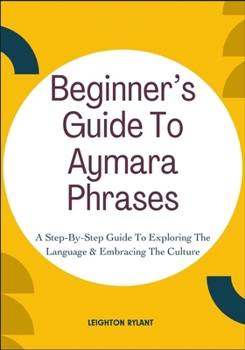
Beginner's Guide To Aymara Phrases: A Step-By-Step Guide To Exploring The Language & Embracing The Culture
No Customer Reviews

The Aymara language is one of the most ancient and culturally rich indigenous languages of the Andean region in South America. It holds a significant place not only as a means of communication but also as a profound vessel of history, tradition, identity, and worldview for the Aymara people. Predominantly spoken around the high-altitude Altiplano plateau spanning parts of Bolivia, Peru, and northern Chile, Aymara is an emblematic language that reflects the resilience and cultural depth of its speakers.
Linguistic Characteristics
Linguistically, Aymara belongs to the Jaqi language family, which also includes the related Jaqaru and Kawki languages spoken in smaller Andean communities. It is a polysynthetic and agglutinative language, meaning it forms complex words by combining multiple morphemes (smallest units of meaning) to express ideas that in other languages might require entire phrases or sentences. This feature allows Aymara speakers to convey nuanced and highly specific meanings in compact forms.
One of the most fascinating aspects of Aymara is its unique conception of time and space. For example, in Aymara, the past is often conceptualized as being "in front" of the speaker, and the future "behind," which is the opposite of many other languages. This reflects a worldview where the past is known and visible, while the future is unknown and unseen. Such linguistic structures offer valuable insights into the cultural and philosophical perspectives of the Aymara people.
Phonologically, Aymara is characterized by a relatively simple vowel system but a rich consonant inventory, including glottalized and aspirated consonants. The language's syntax generally follows a subject-object-verb (SOV) order, which differs from the subject-verb-object (SVO) order common in English and Spanish.
Cultural and Social Importance
For the Aymara people, their language is not only a practical tool but a vital element of cultural identity and social cohesion. Aymara oral traditions encompass folklore, poetry, music, and rituals that have been transmitted through generations. These traditions carry the collective memory, values, and cosmology of the community.
Despite centuries of colonization and external pressures, the Aymara language has demonstrated remarkable resilience. Efforts to revitalize and preserve Aymara have increased significantly in recent decades, with governments, educational institutions, and indigenous organizations promoting bilingual education, literature, and media in Aymara. This resurgence underscores the importance of the language for indigenous rights and cultural heritage in the modern era.
Contemporary Relevance and Challenges
Today, Aymara continues to be spoken by approximately two million people, making it one of the most widely spoken indigenous languages in South America. It serves as a living link to ancestral knowledge and continues to adapt to contemporary realities. However, like many indigenous languages worldwide, Aymara faces challenges such as language shift, urbanization, and the dominance of national languages like Spanish.
Preserving and promoting Aymara is crucial not only for linguistic diversity but also for sustaining the cultural richness of the Andean region. Learning the Aymara language opens a window into a unique linguistic system and a vibrant culture with deep historical roots.
Linguistic Characteristics
Linguistically, Aymara belongs to the Jaqi language family, which also includes the related Jaqaru and Kawki languages spoken in smaller Andean communities. It is a polysynthetic and agglutinative language, meaning it forms complex words by combining multiple morphemes (smallest units of meaning) to express ideas that in other languages might require entire phrases or sentences. This feature allows Aymara speakers to convey nuanced and highly specific meanings in compact forms.
One of the most fascinating aspects of Aymara is its unique conception of time and space. For example, in Aymara, the past is often conceptualized as being "in front" of the speaker, and the future "behind," which is the opposite of many other languages. This reflects a worldview where the past is known and visible, while the future is unknown and unseen. Such linguistic structures offer valuable insights into the cultural and philosophical perspectives of the Aymara people.
Phonologically, Aymara is characterized by a relatively simple vowel system but a rich consonant inventory, including glottalized and aspirated consonants. The language's syntax generally follows a subject-object-verb (SOV) order, which differs from the subject-verb-object (SVO) order common in English and Spanish.
Cultural and Social Importance
For the Aymara people, their language is not only a practical tool but a vital element of cultural identity and social cohesion. Aymara oral traditions encompass folklore, poetry, music, and rituals that have been transmitted through generations. These traditions carry the collective memory, values, and cosmology of the community.
Despite centuries of colonization and external pressures, the Aymara language has demonstrated remarkable resilience. Efforts to revitalize and preserve Aymara have increased significantly in recent decades, with governments, educational institutions, and indigenous organizations promoting bilingual education, literature, and media in Aymara. This resurgence underscores the importance of the language for indigenous rights and cultural heritage in the modern era.
Contemporary Relevance and Challenges
Today, Aymara continues to be spoken by approximately two million people, making it one of the most widely spoken indigenous languages in South America. It serves as a living link to ancestral knowledge and continues to adapt to contemporary realities. However, like many indigenous languages worldwide, Aymara faces challenges such as language shift, urbanization, and the dominance of national languages like Spanish.
Preserving and promoting Aymara is crucial not only for linguistic diversity but also for sustaining the cultural richness of the Andean region. Learning the Aymara language opens a window into a unique linguistic system and a vibrant culture with deep historical roots.
Format:Paperback
Language:English
ISBN:B0FLKN6JRW
ISBN13:9798296696144
Release Date:August 2025
Publisher:Independently Published
Length:94 Pages
Weight:0.39 lbs.
Dimensions:0.2" x 7.0" x 10.0"
Related Subjects
TravelCustomer Reviews
0 rating
Copyright © 2026 Thriftbooks.com
Terms of Use | Privacy Policy | Do Not Sell/Share My Personal Information | Cookie Policy | Cookie Preferences | Accessibility Statement
ThriftBooks ® and the ThriftBooks ® logo are registered trademarks of Thrift Books Global, LLC
ThriftBooks ® and the ThriftBooks ® logo are registered trademarks of Thrift Books Global, LLC
