


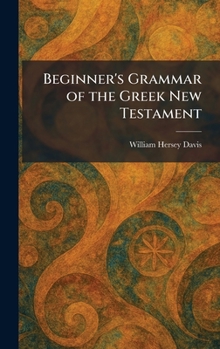
Beginner's Grammar of the Greek New Testament

"Beginner's Grammar of the Greek New Testament" is a comprehensive and accessible guide designed for students and scholars seeking to master the primary language of the Christian scriptures. This essential instructional work provides a clear and systematic introduction to Koine Greek, the dialect in which the New Testament was originally composed. W. Hersey Davis offers a structured approach to linguistic study, covering fundamental aspects of grammar, syntax, and vocabulary that are crucial for accurate biblical interpretation.
The book is tailored specifically for the beginner, breaking down complex grammatical concepts into manageable lessons. By focusing on the unique nuances of the Greek text, it empowers readers to engage more deeply with the original writings of the apostles and early church. Each chapter builds upon the last, providing the tools necessary to move from basic translation to a more nuanced understanding of scriptural passages. Whether used in a classroom setting or for independent study, "Beginner's Grammar of the Greek New Testament" remains a valuable resource for anyone desiring to bridge the gap between modern translations and the historical Greek foundation of the New Testament.
This work has been selected by scholars as being culturally important, and is part of the knowledge base of civilization as we know it. This work was reproduced from the original artifact, and remains as true to the original work as possible. Therefore, you may see the original copyright references, library stamps (as most of these works have been housed in our most important libraries around the world), and other notations in the work.
This work is in the public domain in the United States of America, and possibly other nations. Within the United States, you may freely copy and distribute this work, as no entity (individual or corporate) has a copyright on the body of the work.
As a reproduction of a historical artifact, this work may contain missing or blurred pages, poor pictures, errant marks, etc. Scholars believe, and we concur, that this work is important enough to be preserved, reproduced, and made generally available to the public. We appreciate your support of the preservation process, and thank you for being an important part of keeping this knowledge alive and relevant.
Customer Reviews
ThriftBooks® and the ThriftBooks® logo are registered trademarks of Thrift Books Global, LLC
