


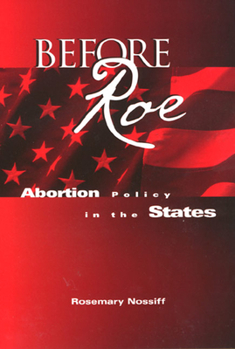
Before Roe: Abortion Policy in the States

Select Format
Select Condition 
Book Overview
Few issues in contemporary U.S> politics have remained on the public agenda so long and so divisively as abortion policy. The landmark Supreme Court decision of Roe v. Waade, which held that laws prohibiting first trimester abortions were illegal because they violated a woman's right to privacy, still generates heated controversy today, a quarter of a century after it was made. The seeds of that controversy were sown in the seven years immediately preceding Roe, when state legislatures tried to reconcile religious opposition to abortion and individuals' civil liberties. In this groundbreaking book, Rosemary Nossiff examines the force that shaped abortion policy during those years, and the ways in which states responded to them. To provide in-depth analysis while still looking broadly at the picture, she studies New York, which passed the most permissive abortion bill in the country, and Pennsylvania, which passed one of the most restrictive. That these two states, which share similar demographic, political, and economic characteristics, should reach two such different outcomes provides a perfect case study for observing political dynamics at the state level. Nossiff examines the medical, religious, and legal discourses employed on both sides of the debate, as well as the role played by feminist discourse. She looks at the role of the political parties in the campaigns, as well as such interest groups as the National Council of Catholic Bishops, the Clergy Consultation Service, the National Organization for Women, and the National Association for the Repeal of Abortion Laws. In addition, she analyzes the strategies used by both sides, as well as partisan and institutionalized developments that facilitated success or failure. Finally, in the Epilogue, she assesses the Roe decision and its aftermath, including an analysis of the pro-life movement in Pennsylvania. As the author remarks, "Without question people's positions on abortion are shaped by a myriad of social, moral, and economic factors. But ultimately abortion policy is shaped in the political arena. This book examines how one of the most intimate decisions a woman makes, whether to continue or terminate a pregnancy, has become one of the most politicized issues in contemporary American politics.
Format:Paperback
Language:English
ISBN:156639810X
ISBN13:9781566398107
Release Date:December 2000
Publisher:Temple University Press
Length:302 Pages
Weight:0.55 lbs.
Dimensions:0.6" x 5.5" x 8.3"
Customer Reviews
1 rating
Case study of pre-Roe abortion policy
Published by Thriftbooks.com User , 23 years ago
Prior to the 1973 Supreme Court decision granting women unrestricted abortion access during the first three months of pregnancy, some states had decided to take initiative in revisiting 19th century abortion restrictions/prohibitions and discarding the now-worthless laws. Because the first anti-abortion laws were passed prior to the development of antiseptic surgery/antibiotics, and had actually led to an increase in organized crime's involvement (eager to profit off of women's desperation) the statues could not accomplish any policy objective by the mid 20th century. Coincidentally, fetal life had never been among the concerns of the original legislators. Doctors could attempt to treat illegal abortion complications, but paradoxically could not offer women services which would prevent the horrific medical crises to begin with. Consequently, a patchwork of reform laws began developing under the recommendation of the American Law Institute, the Clergy Consultation Services, and fair minded legislators who were navigating realization the laws had to be reformed, with uncertainty of how far those reforms should go. Unlike the women's liberationists of the later 1960's who framed abortion as a woman's right and conversely positioned denial as a tool of women's subordination, the professionals involved in these cases also reasoned their control of the process would remove the social stigma then attached to abortion. If women could be screened prior to undergoing an abortion, only virtuous women would receive the procedure and society would be preserved. However easy to disparage their intentions from the vantage point of a self-identified 'third wave' feminist who has never known a world without legalized abortion, I recognize their involvement in the policy process as a critical step in obtaining an eventual nationwide repeal ruling. As the futility of conservative reform statues and widely varying laws became apparent, newly minted reproductive rights activists became less willing to accept anything less than a standardized national repeal. With the Bush administration openly vowing to turn back the clock on women's rights (and the obvious willingness of some state legislatures in helping to achieve that goal) case studies such as these will prove to be an indispensable resource for scholars and activists alike. Understanding our past helps prevent future returns.
Copyright © 2026 Thriftbooks.com
Terms of Use | Privacy Policy | Do Not Sell/Share My Personal Information | Cookie Policy | Cookie Preferences | Accessibility Statement
ThriftBooks ® and the ThriftBooks ® logo are registered trademarks of Thrift Books Global, LLC
ThriftBooks ® and the ThriftBooks ® logo are registered trademarks of Thrift Books Global, LLC
