


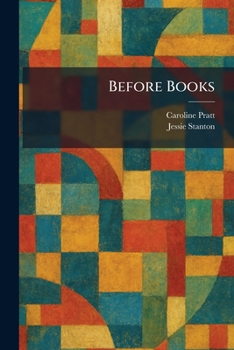
Before Books

"Before Books" is a seminal work in the field of progressive education, chronicling the innovative pedagogical experiments conducted by Caroline Pratt and Jessie Stanton at the City and Country School. Centered on the development of children aged four and five, this volume explores a curriculum built around direct experience and creative play rather than traditional academic instruction. By prioritizing the child's natural curiosity and interaction with their environment, Pratt and Stanton outline a method where learning is an active, investigative process.
The book provides a detailed look at the use of materials-most notably the "unit blocks" designed by Pratt-and how they serve as tools for cognitive and social growth. Through anecdotal records and insightful analysis, the authors demonstrate how young children build an understanding of the world through construction, dramatic play, and community-oriented activities.
As a foundational text for educators and historians of pedagogy, "Before Books" offers timeless insights into the philosophy of early childhood development. It remains an essential resource for those interested in the history of experimental schooling and the enduring power of experiential learning in the formative years.
This work has been selected by scholars as being culturally important, and is part of the knowledge base of civilization as we know it. This work was reproduced from the original artifact, and remains as true to the original work as possible. Therefore, you may see the original copyright references, library stamps (as most of these works have been housed in our most important libraries around the world), and other notations in the work.
This work is in the public domain in the United States of America, and possibly other nations. Within the United States, you may freely copy and distribute this work, as no entity (individual or corporate) has a copyright on the body of the work.
As a reproduction of a historical artifact, this work may contain missing or blurred pages, poor pictures, errant marks, etc. Scholars believe, and we concur, that this work is important enough to be preserved, reproduced, and made generally available to the public. We appreciate your support of the preservation process, and thank you for being an important part of keeping this knowledge alive and relevant.
Customer Reviews
ThriftBooks ® and the ThriftBooks ® logo are registered trademarks of Thrift Books Global, LLC
