


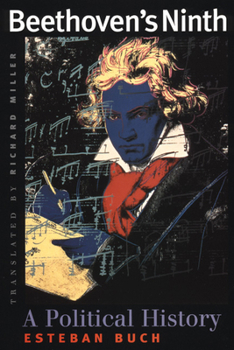
Beethoven's Ninth: A Political History


Select Format
Select Condition 
Book Overview
Who hasn't been stirred by the strains of Beethoven's Ninth Symphony? That's a good question, claims Esteban Buch. German nationalists and French republicans, communists and Catholics have all, in the course of history, embraced the piece. It was performed under the direction of Leonard Bernstein at a concert to mark the fall of the Berlin Wall, yet it also serves as a ghastly and ironic leitmotif in Stanley Kubrick's A Clockwork Orange. Hitler celebrated his birthdays with it, and the government of Rhodesia made it their anthem. And played in German concentration camps by the imprisoned, it also figured prominently at Mitterand's 1981 investiture. In his remarkable history of one of the most popular symphonic works of the modern period, Buch traces such complex and contradictory uses-and abuses-of Beethoven's Ninth Symphony since its premier in 1824. Buch shows that Beethoven consciously drew on the tradition of European political music, with its mix of sacred and profane, military and religious themes, when he composed his symphony. But while Beethoven obviously had his own political aspirations for the piece-he wanted it to make a statement about ideal power-he could not have had any idea of the antithetical political uses, nationalist and universalist, to which the Ninth Symphony has been put since its creation. Buch shows us how the symphony has been "deployed" throughout nearly two centuries, and in the course of this exploration offers what was described by one French reviewer as "a fundamental examination of the moral value of art." Sensitive and fascinating, this account of the tangled political existence of a symphony is a rare book that shows the life of an artwork through time, shifted and realigned with the currents of history.
Format:Paperback
Language:English
ISBN:0226078248
ISBN13:9780226078243
Release Date:May 2004
Publisher:University of Chicago Press
Length:327 Pages
Weight:1.06 lbs.
Dimensions:0.8" x 6.0" x 9.0"
Customer Reviews
3 ratings
Sadly Not Above Politics
Published by Thriftbooks.com User , 22 years ago
One of the world's most famous pieces of music, and arguably the finest work of all symphonies, is Beethoven's Ninth. The theme, the "Ode to Joy," is a tune everyone knows, consisting of only six tones spread over twenty-four bars; you can probably pick it out at the piano even if you don't know piano. If music is, as is often claimed, a universal language, then this is as universal as it gets. And so it is disturbing that no other musical work has been so used as a political tool. _Beethoven's Ninth: A Political History_ (University of Chicago Press) by Esteban Buch gives a history of the often contradictory appropriations of the work during two centuries of wildly differing political times. An intellectual, scholarly look at what people have done with an emotive composition, the book will make readers wonder about how music comes to convey anything to us, and whether there is a moral value to art. The words of the more agreeable song consist of very rich appeals such as that all men will be brothers under the wing of joy, and that the millions should embrace in a kiss for all the world. (I cannot help feeling that the joy conveyed in the music is more likely to be received by those who don't know German.) At least the lyrics are not a simple manifesto; because of this, though, and because of the universality of the appeal to joy and of the tune itself, the Ninth has become distinctly political music. The German nationalists adopted it in the nineteenth century at the same time the French detected that it was the soul of liberty, equality, and fraternity. Communists hear a call to classless brotherhood. Catholics have found the literally divine in it. Hitler liked to have it played on his birthdays. It was played in his concentration camps. The BBC played it as an anti-Nazi symbol. Cleared of the stain of Nazism, the tune in 1985 became the official anthem of Europe. The tune, that is, under the re-written form by Herbert von Karajan, former Nazi party member. The European anthem is wordless. The tune became the Rhodesian national anthem in 1974, an anthem to apartheid. It was played in celebration of the Berlin wall coming down. (Bernstein conducted, and "freedom" was substituted for the word "joy.") The Ninth has affected our technology; when the CD was unveiled, the duration of the music on one CD was selected to allow all the Ninth Symphony to go on one disc. The clearest artistic demonstration of the ambiguity of this multi-significant music was in Kubrick's _A Clockwork Orange_, where, with all the freedom he can handle, droog Alex responds to the Ninth with visions of lovely ultraviolence. The film uses an electronically synthesized version, a Ninth as queer as a clockwork orange. It would be nice to think that a paean whose main line is "All men will be brothers" would somehow rise above politics. Buch not only shows that this did not happen, he has set out all the contradictory claims on the music that started sh
Beauty Is Borrowed to Stand for Subjective "Truth"
Published by Thriftbooks.com User , 22 years ago
Beethoven's Ninth: A Political History is a rare book in considering both the sources of political myths and their expressions . . . from the perspective of one part of the fourth movement of Beethoven's Ninth Symphony, that work of classic genius, The Ode to Joy.Everyone has their own associations for Beethoven's Ninth. For most people, these associations are positive . . . such as remembering a wonderful concert. For others, the connections are more sinister . . . such as those who remember The Ode to Joy as Rhodesia's anthem, Hitler's use of the music for the Third Reich (including encouragement of playing the music in concentration camps), and the disturbing scene in "A Clockwork Orange." Unless you know German, however, the music is mostly sound. What do those words say? Did you know that they are based on Schiller's poem in which the ideal is expressed that "All men will become brothers"? In that context, the work takes on a whole new dimension. Also, its use by tyrants and those who do not favor brotherhood becomes much more egregious as an inappropriate thing to do.Basically, the work is so appealing to people that they want to use it . . . without necessarily honoring its meaning. For many decades, many people have falsely claimed that Schiller meant the work to be an Ode to Freedom rather than Joy. Although there's no basis for that claim, the desire to turn this work to that theme caused Leonard Bernstein to change the wording in that way in his concerts to celebrate the demolition of the Berlin Wall. So even the nontyrants are tempted to misappropriate the message.This book does more than recount those appropriations and misappropriations. You will also learn about the rise of national anthems in Europe, the building of Beethoven's myth, and how The Ode to Joy has become the anthem of the united Europe that is emerging today.As a side note, I was pleased to see that the words for the national anthems were so carefully developed in the text and connected to the prevailing political themes. I found much improved understanding of these works by seeing their words in the same book in English.If you are a fan of those who criticize pomposity and ignorance by quoting them at length, then you will have a lot of fun with this book by seeing how many people have made fatuous statements about Beethoven and The Ode to Joy. How could the book have been better? I would have liked a little more about the music itself. It's a shame that there's not an audio version that could include snatches of the music. As it is, the book is filled with scores and lyrics, so if you can read music (and hum along) you can almost provide your own accompaniment. After you finish this book, I encourage you to share The Ode to Joy (along with the words) with someone who does not know the music. And then explain what the music and the words mean to you. In that way, we can keep the true heritage of this remarkable music alive.
The Trials and Tribulations of a Magnum Opus
Published by Thriftbooks.com User , 22 years ago
I verily believe poor old Beethoven would roll right over if he were to learn just to what extent his crowning achievement has been employed over the last few centuries. The premise of this book is as interesting as it sounds; I hardly need to parrot the synopsis provided above. I enjoyed this book quite a lot, especially since I have had, with profound gratitude, to study the piece. Its discussion of the Maestro's other works prompted me to buy the complete cycle of Symphonies by Gardiner. Buch does an excellent job of establishing the historical context under which the Symphony was born, and even though it felt at times as if this preparation veered too far from the Ninth itself, the background learning is eminently helpful for better understanding the European traditions that held sway over the work itself. Indeed, the book focuses almost entirely on the Ninth as a monument of European culture and limits discussion, for the most part, to the evolultion of its European reception and interpretation. Quite understandable, and rather thorough, at that; all the same, I would have liked at least a little bit about how the Ninth was "used" in other societies - I imagine that the trans-cultural exchange is a fascinating occasion to examine how non-European nations recieved a work so paradoxical: universal yet utterly European. Additionally, I felt that the intensity of the book diminished the closer it was to finishing; but I suppose the nearer one is to history, the less one can judge too firmly. In the main, Buch has written a manifestly interesting narrative and I cannot but recommend it; Miller's translation was superb and felt as though "Beethoven's Ninth: A Political History" fared a lot better in translation than did its namesake.
Copyright © 2026 Thriftbooks.com Terms of Use
| Privacy Policy | Do Not
Sell/Share My Personal Information | Cookie Policy | Cookie Preferences | Accessibility Statement
ThriftBooks® and the ThriftBooks® logo are registered trademarks of Thrift Books Global, LLC
ThriftBooks® and the ThriftBooks® logo are registered trademarks of Thrift Books Global, LLC
