


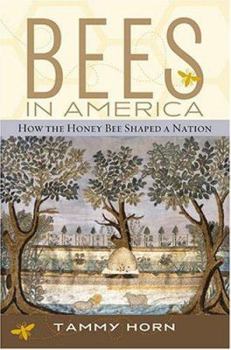
Bees in America: How the Honey Bee Shaped a Nation

Select Format
Select Condition 
Book Overview
Honey bees--and the qualities associated with them--have quietly influenced American values for four centuries. During every major period in the country's history, bees and beekeepers have represented order and stability in a country without a national religion, political party, or language. Bees in America is an enlightening cultural history of bees and beekeeping in the United States. Tammy Horn, herself a beekeeper, offers a varied social and technological history from the colonial period, when the British first introduced bees to the New World, to the present, when bees are being used by the American military to detect bombs. Early European colonists introduced bees to the New World as part of an agrarian philosophy borrowed from the Greeks and Romans. Their legacy was intended to provide sustenance and a livelihood for immigrants in search of new opportunities, and the honey bee became a sign of colonization, alerting Native Americans to settlers' westward advance. Colonists imagined their own endeavors in terms of bees' hallmark traits of industry and thrift and the image of the busy and growing hive soon shaped American ideals about work, family, community, and leisure. The image of the hive continued to be popular in the eighteenth century, symbolizing a society working together for the common good and reflecting Enlightenment principles of order and balance. Less than a half-century later, Mormons settling Utah (where the bee is the state symbol) adopted the hive as a metaphor for their protected and close-knit culture that revolved around industry, harmony, frugality, and cooperation. In the Great Depression, beehives provided food and bartering goods for many farm families, and during World War II, the War Food Administration urged beekeepers to conserve every ounce of beeswax their bees provided, as more than a million pounds a year were being used in the manufacture of war products ranging from waterproofing products to tape. The bee remains a bellwether in modern America. Like so many other insects and animals, the bee population was decimated by the growing use of chemical pesticides in the 1970s. Nevertheless, beekeeping has experienced a revival as natural products containing honey and beeswax have increased the visibility and desirability of the honey bee. Still a powerful representation of success, the industrious honey bee continues to serve both as a source of income and a metaphor for globalization as America emerges as a leader in the Information Age.
Format:Hardcover
Language:English
ISBN:081312350X
ISBN13:9780813123509
Release Date:April 2006
Publisher:University Press of Kentucky
Length:352 Pages
Weight:1.50 lbs.
Dimensions:1.1" x 6.4" x 9.3"
Grade Range:Postsecondary and higher
Customer Reviews
5 ratings
engrossing
Published by Thriftbooks.com User , 20 years ago
Beekeeping in the American historical context. Though the text is a bit academic, I picked up this book and couldn't put it down. I read it in about 3 days. The numerous ways that the honey bee and beekeeping has woven themselves into our history and culture is fascinating. Ms. Horn has done some tremendous research on the subject.
history of bees
Published by Thriftbooks.com User , 21 years ago
a very good book about the beekeeping and the history of bees in a nation which envy by others
Bees In America: How The Honey Bee Shaped A Nation
Published by Thriftbooks.com User , 21 years ago
Excellent review of history of bees-beekeeping in America from a historical, cultural and global perspective. It is not a technically laden text. This would be a great book for extra credit reading - discussion for an American History college/university course. It is highly recommended for both general and scholarly readers.
A Great Read !
Published by Thriftbooks.com User , 21 years ago
This is a very enjoyable book. The author has taken a relatively unknown topic ( unless you're a beekeeper ), and written a book that is simply very interesting. She's blended history, science, economics, and even religion into a book that is easy to read. How did that jar of honey get into your shop ? Why are people as diverse as rocker Tom Petty, disco diva Gloria Gaynor, and actor Peter Fonda included in a book about bees ? Not only did I learn why, but I liked the way the author took us on a journey thru bee-land.
Bees for Americans, and Americans for Bees
Published by Thriftbooks.com User , 21 years ago
America owes its liberty to the honeybee. That was the opinion of no other than George Washington. The story, recounted in _Bees in America: How the Honey Bee Shaped a Nation_ (University Press of Kentucky) by Tammy Horn, is only one aspect of bee folklore, science, and history recounted in a delightful book full of anecdotes and facts which will spark admiration for this sometimes overlooked part of our nation's agriculture. The way the bees won the American Revolution is that a Quaker girl was given a message to deliver to Washington concerning an imminent attack by Cornwallis. The resourceful messenger realized she was being pursued by Redcoats, but as she galloped, she was able to overturn beehives in her path. The bees went after the Redcoats, Washington got his intelligence, and, well, the rest is history. Americans have always loved the honey bee not only for its delicious product (and the wax), but also because the hive is a symbol for a perfectly run society. Paradoxically, it is not a good symbol for our society. We are loosely organized, everyone joins in the pursuit of happiness in an idiosyncratic way, and we have no official religion, political party, or even family structure. Bees are little robots, and their regimented roles are fine for them, but not an example for our human ways. Their industry, however, we like; it is an admirable trait to be "as busy as a bee." We like that the bees make a home for themselves, and that they work hard to ensure that the home will be able to last the winter; they are thrifty, efficient animals. Americans are quite likely to think that if someone is poor, he ought to take a lesson from the bee. Bees were transported, with great difficulty and much bee mortality, to the earliest of American colonies. They took to the new land as readily as the human immigrants, going wild and providing sustenance and employment for bee hunters (as opposed to beekeepers). Many Indians learned to value bees and their products, but one settler wrote that the Osage Indians in 1836 had held a day of mourning because they had found a swarm of bees; it was a sign that the Osage ways were doomed. Railroad men were horrified at the initial idea of hauling bees, and the man who convinced them to do so in 1907 had to ride along with his hives. _The American Bee Journal_ editorialized in 1903 that automobiles had a distinct advantage compared to horse-drawn wagons for carrying bees, because autos "...will never get frightened, run away and break things by being attacked by cross bees." The benefits to agriculture from bee pollination are so great that in California, especially with its almond orchards, beekeepers make more money by renting out bees for pollination than they do selling honey or wax. Horn examines such topics as the rehabilitation of returning shell-shocked veterans by beekeeping, the tall tales that surround bees and bee hunters, the use of the bee example by sex educators (who used birds as
Copyright © 2026 Thriftbooks.com
Terms of Use | Privacy Policy | Do Not Sell/Share My Personal Information | Cookie Policy | Cookie Preferences | Accessibility Statement
ThriftBooks ® and the ThriftBooks ® logo are registered trademarks of Thrift Books Global, LLC
ThriftBooks ® and the ThriftBooks ® logo are registered trademarks of Thrift Books Global, LLC
