


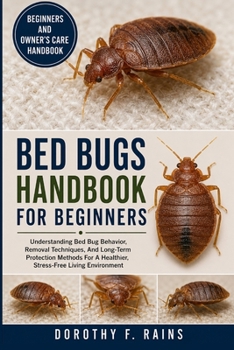
Bed Bugs Handbook for Beginners: Understanding Bed Bug Behavior, Removal Techniques, And Long-Term Protection Methods For A Healthier, Stress-Free Liv
No Customer Reviews

Introduction to Bed Bugs
What Bed Bugs Are
Bed bugs are small, wingless insects that have fascinated and frustrated people for centuries. Despite their tiny size, they are remarkably resilient and have a capacity to thrive in environments where other pests might struggle. Adult bed bugs typically measure about five to seven millimeters in length, roughly the size of an apple seed, and they have flat, oval-shaped bodies. Their color ranges from reddish-brown to dark brown, depending on when they last fed. After feeding, they become engorged, taking on a more reddish hue and a swollen appearance.
Bed bugs are exclusively hematophagous, meaning they feed only on blood. Humans are their preferred hosts, though in their absence, they can feed on other warm-blooded animals such as pets, including dogs, cats, and rodents. What makes bed bugs particularly difficult to detect is their nocturnal nature. They are primarily active at night, coming out to feed under the cover of darkness when people are asleep. Their bites are often painless at the moment of feeding, which allows them to go unnoticed for extended periods.
Although bed bugs do not transmit diseases in the same way that mosquitoes or ticks do, their bites can cause considerable discomfort, irritation, and psychological stress. Bites often appear as clusters of red, itchy welts, typically on exposed areas such as the arms, legs, and neck. Some people develop mild allergic reactions, while others may experience more significant skin irritation or secondary infections due to scratching. Beyond the physical effects, the presence of bed bugs can cause anxiety, sleepless nights, and even social stigma, making their management a priority for anyone encountering an infestation.
Bed bugs belong to the genus Cimex, with the most common species affecting humans being Cimex lectularius, often referred to as the common bed bug. There is also Cimex hemipterus, which is more prevalent in tropical and subtropical regions. Both species share similar behaviors, life cycles, and methods of infestation, making them equally challenging to control. Despite their small size, their ability to reproduce quickly and hide in minute cracks and crevices makes them an enduring problem in homes, hotels, and public spaces.
The History of Bed Bugs
The relationship between people and bed bugs is ancient and complex. Bed bugs have coexisted with humans for thousands of years, and historical records show that they were already a nuisance in early civilizations. Archaeologists have discovered evidence of bed bugs in ancient Egyptian tombs, indicating that these insects were present in human dwellings as far back as 3,500 years ago. Descriptions of "bed insects" can also be found in classical texts from Greece and Rome, suggesting that people have been aware of their irritating presence for millennia.
During the Middle Ages, bed bugs were widespread across Europe. They were not considered particularly dangerous, but their bites were annoying, and infestations were a common household problem. People of all social classes were affected, from peasants living in rural cottages to wealthy nobles with lavish residences. It was not until the 17th and 18th centuries that efforts to control bed bugs began to gain more scientific attention, with early pest control measures often involving the use of oils, herbs, and fumigants.
In the 20th century, the introduction of synthetic insecticides, particularly DDT, led to a significant decline in bed bug populations in many developed countries. By the mid-20th century, bed bugs had become relatively rare in homes and hotels in North America and Europe. However, despite this temporary success, bed bugs were never completely eradicated. Small populations survived in urban areas, and their resurgence in the 21st century has demonstrated just how resilient these insects can be.
What Bed Bugs Are
Bed bugs are small, wingless insects that have fascinated and frustrated people for centuries. Despite their tiny size, they are remarkably resilient and have a capacity to thrive in environments where other pests might struggle. Adult bed bugs typically measure about five to seven millimeters in length, roughly the size of an apple seed, and they have flat, oval-shaped bodies. Their color ranges from reddish-brown to dark brown, depending on when they last fed. After feeding, they become engorged, taking on a more reddish hue and a swollen appearance.
Bed bugs are exclusively hematophagous, meaning they feed only on blood. Humans are their preferred hosts, though in their absence, they can feed on other warm-blooded animals such as pets, including dogs, cats, and rodents. What makes bed bugs particularly difficult to detect is their nocturnal nature. They are primarily active at night, coming out to feed under the cover of darkness when people are asleep. Their bites are often painless at the moment of feeding, which allows them to go unnoticed for extended periods.
Although bed bugs do not transmit diseases in the same way that mosquitoes or ticks do, their bites can cause considerable discomfort, irritation, and psychological stress. Bites often appear as clusters of red, itchy welts, typically on exposed areas such as the arms, legs, and neck. Some people develop mild allergic reactions, while others may experience more significant skin irritation or secondary infections due to scratching. Beyond the physical effects, the presence of bed bugs can cause anxiety, sleepless nights, and even social stigma, making their management a priority for anyone encountering an infestation.
Bed bugs belong to the genus Cimex, with the most common species affecting humans being Cimex lectularius, often referred to as the common bed bug. There is also Cimex hemipterus, which is more prevalent in tropical and subtropical regions. Both species share similar behaviors, life cycles, and methods of infestation, making them equally challenging to control. Despite their small size, their ability to reproduce quickly and hide in minute cracks and crevices makes them an enduring problem in homes, hotels, and public spaces.
The History of Bed Bugs
The relationship between people and bed bugs is ancient and complex. Bed bugs have coexisted with humans for thousands of years, and historical records show that they were already a nuisance in early civilizations. Archaeologists have discovered evidence of bed bugs in ancient Egyptian tombs, indicating that these insects were present in human dwellings as far back as 3,500 years ago. Descriptions of "bed insects" can also be found in classical texts from Greece and Rome, suggesting that people have been aware of their irritating presence for millennia.
During the Middle Ages, bed bugs were widespread across Europe. They were not considered particularly dangerous, but their bites were annoying, and infestations were a common household problem. People of all social classes were affected, from peasants living in rural cottages to wealthy nobles with lavish residences. It was not until the 17th and 18th centuries that efforts to control bed bugs began to gain more scientific attention, with early pest control measures often involving the use of oils, herbs, and fumigants.
In the 20th century, the introduction of synthetic insecticides, particularly DDT, led to a significant decline in bed bug populations in many developed countries. By the mid-20th century, bed bugs had become relatively rare in homes and hotels in North America and Europe. However, despite this temporary success, bed bugs were never completely eradicated. Small populations survived in urban areas, and their resurgence in the 21st century has demonstrated just how resilient these insects can be.
Format:Paperback
Language:English
ISBN:B0H1WWKB8V
ISBN13:9798196937590
Release Date:May 2026
Publisher:Independently Published
Length:166 Pages
Weight:0.51 lbs.
Dimensions:0.3" x 6.0" x 9.0"
Customer Reviews
0 rating
Copyright © 2026 Thriftbooks.com
Terms of Use | Privacy Policy | Do Not Sell/Share My Personal Information | Cookie Policy | Cookie Preferences | Accessibility Statement
ThriftBooks ® and the ThriftBooks ® logo are registered trademarks of Thrift Books Global, LLC
ThriftBooks ® and the ThriftBooks ® logo are registered trademarks of Thrift Books Global, LLC
