


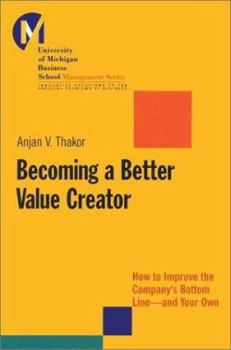
Becoming a Better Value Creator: How to Improve the Company's Bottom Line - And Your Own

Select Format
Select Condition 
Book Overview
Why do some companies perform beyond expectation year after year while others start out strong but quickly fizzle? The answer lies in their ability to create long-term value. In this book, a leading professor at the top-ranked University of Michigan Business School presents five keys to creating value by incorporating the efforts of marketing, manufacturing, human resources, and finance in a strategy for continuing bottom-line success. His fresh look at what makes companies work shows managers how they can identify the factors that create value and use them to benefit their organizations and their own careers.
Format:Hardcover
Language:English
ISBN:0787953083
ISBN13:9780787953089
Release Date:August 2000
Publisher:Jossey-Bass
Length:208 Pages
Weight:1.14 lbs.
Dimensions:9.7" x 0.9" x 6.4"
Customer Reviews
2 ratings
Shift Self Interest to Better Satisfy Self Interest
Published by Thriftbooks.com User , 25 years ago
This book is built around the proposition that we can all be more effective by making our efforts build on one another's rather than working at cross purposes. Most would agree with that point. You cannot build a bridge if another part of your group is demolishing what you have done. The culprit when this kind of conflict occurs turns out to be a misunderstanding of what the common purpose is. So think of this book has a paean to, guide and workbook for overcoming the communications stall about your what your organization's purpose is.Properly done, that purpose creates economic value. In a for-profit company, this means having cash earnings in excess of input costs and the opportunity costs of capital. For an individual, you can apply the same concept. In a non-profit organization, you can define economic value as creating benefits for those you serve in excess of their costs and the opportunity costs of the efforts involved. Professor Thakor makes an intersting argument about why one should overcome this stall. He feels that this is the path to greater self-fulfillment. "Creating value is how we achieve self-fulfillment and realize our unique potential." He also argues that there are career advantages. Those who "get ahead fastest . . . with the [most] energy and enthusiasm, and are the happiest" are those who are highly successful in value creation. I didn't quite follow the argument on this point (which is not spelled out very much, except for stating the conclusions), but would have enjoyed learning more about his research in this area. Why is this so? Perhaps it is related to the joys of learning, creativity, accomplishment, and recognition. To establish greater value creation, he starts with the reader. He poses questions for you to answer, whether you are the CEO or a file room clerk.1. "What does value mean to your organization? 2. "What does value mean to you?"3. "What are all the activities your organization is involved in that create value?" 4. "What activities are you engaged in that create value?" 5. "What is your organization's strategy?"6. "What is your personal strategy in the organization?"7. "How do you and your organization measure success?"8. "How do you personally set your own expectations?"9. "How fast are you at creating value?"10. "What can you do to improve speed without compromising quality?"The author identifies four major hurdles that must be overcome to improve economic value: a fuzzy sense of value and what creates it (thinking about market share while profits are killed); self-focused behavior that harms the organization (spending budgets to protect them for the next year); negative internal competition (sales contests that expand volume unprofitably); and functional operation focuses (trying to get costs down in ways that hurt customers).To overcome these tendencies, Professor Thakor proposes getting the right balance of creativity, collaboration, control and competitive focus
How Valuable Are You?
Published by Thriftbooks.com User , 25 years ago
This volume is one in the University of Michigan Business School Management Series. According to Thakor, sustained value creation depends on a mastery of five "secrets" of great value creators: 1. A clear definition of what value creation means to your organization and to you2. A clear understanding of the multiple value creation perspectives and activities that exist at the individual and organizational levels3. A clear understanding of the organization's strategy as well as a clearly defined personal strategy for success4. A personal measure of success that exceeds organizational expectations5. A mastery of speed without sacrificing qualityThakor correctly stresses the importance of understanding what "value" means, both to you and to your organization. (Is your definition of "value" in proper alignment with your organization's definition of it?) Also, he stresses the importance of continually refining your personal strategy as well as continually improving your motivation to derive internal satisfaction from your efforts. Also, he offers a caution and then a recommendation: "No matter how well you are creating value, there is always somebody out there doing something better than you are. Find out what that something is. Learn that what makes these people better at it [hence more valuable] than you. Discover their `rules' and adapt them to your setting to improve your effectiveness."Most organizations claim that their most valuable assets "walk out the door at the end of each day." Of course, the reference is to people -- human capital. Perhaps no employee is indispensable but some employees are most valuable than others. However harsh it may seem, employees who create no value have no value. Read Thakor's book. It can help you to create greater value for your organization and thereby increase and enhance your own value to that organization...while perhaps, in process, increasing and enhancing your appeal to other organizations. Think about it....
Copyright © 2026 Thriftbooks.com Terms of Use
| Privacy Policy | Do Not
Sell/Share My Personal Information | Cookie Policy | Cookie Preferences | Accessibility Statement
ThriftBooks® and the ThriftBooks® logo are registered trademarks of Thrift Books Global, LLC
ThriftBooks® and the ThriftBooks® logo are registered trademarks of Thrift Books Global, LLC
