


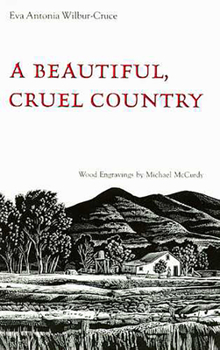
A Beautiful, Cruel Country

Select Format
Select Condition 
Book Overview
Revised
Format:Paperback
Language:English
ISBN:0816511942
ISBN13:9780816511945
Release Date:May 1990
Publisher:University of Arizona Press
Length:336 Pages
Weight:1.15 lbs.
Dimensions:0.9" x 5.9" x 9.0"
Customer Reviews
4 ratings
Have read and re-read and will again
Published by Thriftbooks.com User , 7 years ago
My father grew up in this country and I have heard his stories which parallel the authors. I know the country , having lived in Tucson for many years. I highly recommend it to any South Westerner.
Beautiful Cruel Land
Published by Thriftbooks.com User , 17 years ago
The author's recollections of her childhood are quite vivid. When I finished the book I ony wished she had continued her memories into several more books
A valuable addition to the library of students of Southwest
Published by Thriftbooks.com User , 27 years ago
It is not often one can read of the intermingling of cultures so successfully combined as in Eva Wilber-Cruce's work. It is remarkable for its objectivity, its vivacity, and as a lesson of how best to get along with one's neighbors. Eva's recollections as a child and woman are remarkable and is a person easily taken to one's heart. Her considerable life is a valise which contains a portfolio of memories of the most meaningful sort. I would compare her book with Mari Sandoz' Old Jules; both about frontier life, one in the SW, the other in Nebraska. The reader has the added benefit of increasing his or her Spanish vocabulary that reflects the lifestyle in which Eva was raised. Beautifully written. An added plus for me was the reference to Archbishop Salpointe who was the heir to "Lamy of Sante Fe." It's a treat when a book ties in with another source written by a respected historical author like Paul Horgan.
Poetic woman's view of Arizona in the early 1900's.
Published by Thriftbooks.com User , 27 years ago
Eva Wilbur-Cruce describes memories as far back as when she was three, and captures the wild yet captivating valleys of the Arizona/Mexico border, painting word pictures of Mexican ranchers, Tohono O'odham Indians and many other cultures intermingling. It is a story of how to live life to the fullest, as she learned it from nature, her family and those around her. She has learned well what the beautiful cruel country has to teach and she passes it on through artistic imagery.
Copyright © 2026 Thriftbooks.com
Terms of Use | Privacy Policy | Do Not Sell/Share My Personal Information | Cookie Policy | Cookie Preferences | Accessibility Statement
ThriftBooks ® and the ThriftBooks ® logo are registered trademarks of Thrift Books Global, LLC
ThriftBooks ® and the ThriftBooks ® logo are registered trademarks of Thrift Books Global, LLC
