


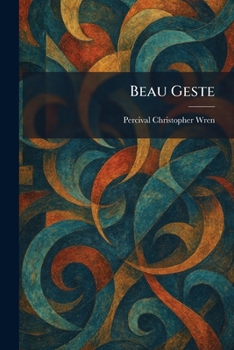
Beau Geste

"Beau Geste" is a seminal masterpiece of adventure and mystery, famously set against the harsh and unforgiving landscape of the Sahara Desert. The narrative follows the three Geste brothers-Michael, Digby, and John-who leave their aristocratic English home under a cloud of suspicion following the disappearance of a priceless sapphire known as the "Blue Water." To protect their family's honor and cover for one another, the brothers enlist in the legendary French Foreign Legion.
This classic novel blends high-stakes military action with a gripping detective story, as the brothers endure the brutal discipline of the Legion while facing external threats from desert tribes and internal treachery. Percival Christopher Wren's evocative writing brings to life the camaraderie and courage required to survive in one of the world's most demanding military forces. A timeless tale of loyalty, sacrifice, and the unbreakable bonds of brotherhood, "Beau Geste" remains a definitive work in the genre of colonial adventure and a thrilling exploration of the lengths individuals will go to preserve their integrity.
This work has been selected by scholars as being culturally important, and is part of the knowledge base of civilization as we know it. This work was reproduced from the original artifact, and remains as true to the original work as possible. Therefore, you may see the original copyright references, library stamps (as most of these works have been housed in our most important libraries around the world), and other notations in the work.
This work is in the public domain in the United States of America, and possibly other nations. Within the United States, you may freely copy and distribute this work, as no entity (individual or corporate) has a copyright on the body of the work.
As a reproduction of a historical artifact, this work may contain missing or blurred pages, poor pictures, errant marks, etc. Scholars believe, and we concur, that this work is important enough to be preserved, reproduced, and made generally available to the public. We appreciate your support of the preservation process, and thank you for being an important part of keeping this knowledge alive and relevant.
Customer Reviews
ThriftBooks ® and the ThriftBooks ® logo are registered trademarks of Thrift Books Global, LLC
