


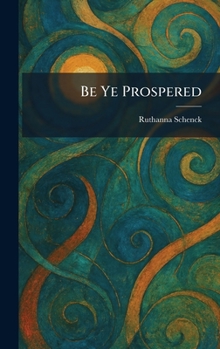
Be Ye Prospered

"Be Ye Prospered" is a spiritual guide exploring the principles of divine abundance and the metaphysical laws of success. Written during the height of the New Thought movement, Ruthanna Schenck provides readers with a practical framework for achieving financial and personal prosperity through faith and mental discipline. The work emphasizes that true wealth is a manifestation of spiritual consciousness and that individuals can align themselves with universal flow through prayer, affirmation, and right thinking.
Schenck explores the relationship between the individual and the divine, offering insights into how one might overcome limiting beliefs and embrace a life of plenty. By examining the biblical and spiritual foundations of success, the author encourages a mindset of gratitude and expectation. This classic of spiritual self-help remains a significant text for those interested in the history of the prosperity gospel and the practical application of spiritual principles to material well-being. It serves as an empowering resource for anyone seeking to harmonize their inner life with outward abundance.
This work has been selected by scholars as being culturally important, and is part of the knowledge base of civilization as we know it. This work was reproduced from the original artifact, and remains as true to the original work as possible. Therefore, you may see the original copyright references, library stamps (as most of these works have been housed in our most important libraries around the world), and other notations in the work.
This work is in the public domain in the United States of America, and possibly other nations. Within the United States, you may freely copy and distribute this work, as no entity (individual or corporate) has a copyright on the body of the work.
As a reproduction of a historical artifact, this work may contain missing or blurred pages, poor pictures, errant marks, etc. Scholars believe, and we concur, that this work is important enough to be preserved, reproduced, and made generally available to the public. We appreciate your support of the preservation process, and thank you for being an important part of keeping this knowledge alive and relevant.
Customer Reviews
ThriftBooks ® and the ThriftBooks ® logo are registered trademarks of Thrift Books Global, LLC
