


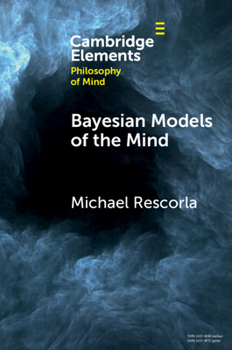
Bayesian Models of the Mind
No Customer Reviews

Bayesian decision theory is a mathematical framework that models reasoning and decision-making under uncertain conditions. The Bayesian paradigm originated as a theory of how people should operate, not a theory of how they actually operate. Nevertheless, cognitive scientists increasingly use it to describe the actual workings of the human mind. Over the past few decades, cognitive science has produced impressive Bayesian models of mental activity. The models postulate that certain mental processes conform, or approximately conform, to Bayesian norms. Bayesian models offered within cognitive science have illuminated numerous mental phenomena, such as perception, motor control, and navigation. This Element provides a self-contained introduction to the foundations of Bayesian cognitive science. It then explores what we can learn about the mind from Bayesian models offered by cognitive scientists.
Format:Paperback
Language:English
ISBN:110895829X
ISBN13:9781108958295
Release Date:January 2025
Publisher:Cambridge University Press
Length:108 Pages
Weight:0.34 lbs.
Dimensions:0.2" x 6.0" x 9.0"
Related Subjects
PhilosophyCustomer Reviews
0 rating
Copyright © 2026 Thriftbooks.com
Terms of Use | Privacy Policy | Do Not Sell/Share My Personal Information | Cookie Policy | Cookie Preferences | Accessibility Statement
ThriftBooks ® and the ThriftBooks ® logo are registered trademarks of Thrift Books Global, LLC
ThriftBooks ® and the ThriftBooks ® logo are registered trademarks of Thrift Books Global, LLC
