


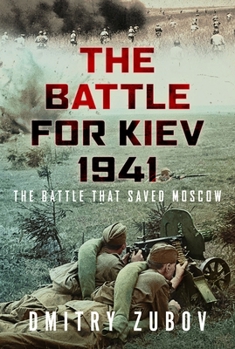
The Battle for Kiev, 1941: The Battle That Saved Moscow
No Customer Reviews

The Battle of Kiev was one of the largest and most devastating encirclement battles of the Second World War. Fought between August and September 1941 during Operation Barbarossa, it pitted the German Army Group South against Soviet forces defending Kiev, the capital and most populous city of the Ukrainian Soviet Socialist Republic.
Initially, the Soviet leader, Joseph Stalin, refused to permit a withdrawal from Kiev, insisting the city be held at all costs. This decision proved critical. German commander Gerd von Rundstedt advanced from the west, while armoured units under Heinz Guderian were redirected southward from central Russia, creating a massive pincer movement. These forces eventually linked up to the east of Kiev, encircling a vast portion of the Soviet Red Army.
The encirclement trapped four Soviet armies. Despite fierce resistance and desperate breakout attempts, the situation became hopeless. Communication broke down, supplies ran out, and German forces systematically reduced the pocket. By late September, the encirclement was complete, and organized Soviet resistance collapsed.
The scale of the disaster was enormous. Around 600,000 to 700,000 Soviet troops were killed, captured, or listed as missing, making it one of the largest encirclements in military history. The Germans also seized huge quantities of equipment and secured control over much of Ukraine, including its vital agricultural and industrial resources.
However, the victory came with strategic consequences. Diverting Guderian's panzer forces south delayed the German advance on Moscow. This pause gave the Soviets time to reinforce their capital and prepare defences that would later halt the German offensive in the winter of 1941.
In The Battle of Kiev, 1941 historian Dmitry Zubov reveals both the effectiveness of German blitzkrieg tactics and the dangers of rigid command decisions. While it was a tactical masterpiece for Germany, it also marked a turning point where early successes began to contribute to longer-term strategic setbacks.
Initially, the Soviet leader, Joseph Stalin, refused to permit a withdrawal from Kiev, insisting the city be held at all costs. This decision proved critical. German commander Gerd von Rundstedt advanced from the west, while armoured units under Heinz Guderian were redirected southward from central Russia, creating a massive pincer movement. These forces eventually linked up to the east of Kiev, encircling a vast portion of the Soviet Red Army.
The encirclement trapped four Soviet armies. Despite fierce resistance and desperate breakout attempts, the situation became hopeless. Communication broke down, supplies ran out, and German forces systematically reduced the pocket. By late September, the encirclement was complete, and organized Soviet resistance collapsed.
The scale of the disaster was enormous. Around 600,000 to 700,000 Soviet troops were killed, captured, or listed as missing, making it one of the largest encirclements in military history. The Germans also seized huge quantities of equipment and secured control over much of Ukraine, including its vital agricultural and industrial resources.
However, the victory came with strategic consequences. Diverting Guderian's panzer forces south delayed the German advance on Moscow. This pause gave the Soviets time to reinforce their capital and prepare defences that would later halt the German offensive in the winter of 1941.
In The Battle of Kiev, 1941 historian Dmitry Zubov reveals both the effectiveness of German blitzkrieg tactics and the dangers of rigid command decisions. While it was a tactical masterpiece for Germany, it also marked a turning point where early successes began to contribute to longer-term strategic setbacks.
Format:Hardcover
Language:English
ISBN:1399052306
ISBN13:9781399052306
Release Date:May 2027
Publisher:Frontline Books
Length:248 Pages
Related Subjects
HistoryCustomer Reviews
0 rating
Copyright © 2026 Thriftbooks.com
Terms of Use | Privacy Policy | Do Not Sell/Share My Personal Information | Cookie Policy | Cookie Preferences | Accessibility Statement
ThriftBooks ® and the ThriftBooks ® logo are registered trademarks of Thrift Books Global, LLC
ThriftBooks ® and the ThriftBooks ® logo are registered trademarks of Thrift Books Global, LLC
