


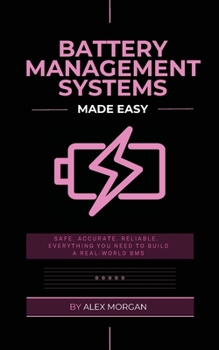
Battery Management Systems Made Easy: A Practical Engineer's Guide to Designing, Building, and Validating Lithium-Ion Battery Management Systems

Modern lithium-ion packs are unforgiving. Push voltage too high and you plate lithium. Charge below freezing and you destroy the cell. Trust a noisy current sensor and your SoC drifts into fantasy. A BMS exists to prevent all of that - but building one that is accurate, safe, and robust is far from trivial.
This book closes the gap between academic electrochemistry and real-world engineering. It is written for the engineer who must take a stack of cells, a microcontroller, and a deadline - and deliver a system that does not catch fire and does not lie about how much energy is left.
What you will learn
How lithium-ion cells really behave: OCV curves, internal resistance, temperature effects, agingHow to design the core BMS algorithms: SoC, SoH, power estimation, balancingHow to architect a complete system: AFEs, current sensing, thermal design, safety pathsHow to implement firmware that is robust, testable, and fault-tolerantHow to validate a pack: test plans, standards, certification, field diagnosticsHow to avoid real failures seen in e-bikes, telecom systems, ESS, and EV prototypesWhy this book is different
Written by an engineer, not a theoristFocus on practical trade-offs, not idealized modelsReal field failures, real numbers, real constraintsClear math without unnecessary derivationsIncludes reference equations, BOM templates, code snippets, and troubleshooting playbooksIf you design, review, or debug lithium-ion battery systems - this book will make your work faster, safer, and more confident.
Customer Reviews
ThriftBooks ® and the ThriftBooks ® logo are registered trademarks of Thrift Books Global, LLC
