


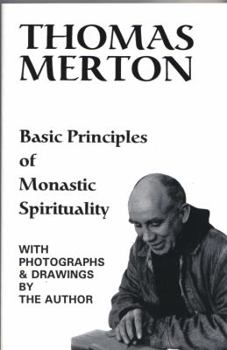
Basic Principles of Monastic Spirituality


No Synopsis Available.
Format:Paperback
Language:English
ISBN:087243222X
ISBN13:9780872432222
Release Date:February 1997
Publisher:Templegate Pub
Length:124 Pages
Weight:0.46 lbs.
Dimensions:8.8" x 0.5" x 5.5"
Related Subjects
Christian Books & Bibles Christian Living Religion Religion & Spirituality SpiritualityCustomer Reviews
2 ratings
Written for monks, but bread for the layperson.
Published by Thriftbooks.com User , 17 years ago
This book was written for monks, and the focus here is to live in Christ ... "Our purpose in life is then to grow in our union with the risen Christ, to lie more and more deeply the life of His Body ..." This book may seem less "ecumenical" than some of his later works contrasting their quest for Christ-union as being more than the Zen quest of liberation. There are also hints "we must be able to see Him in the created things around us - in the hills, the fields, the flowers, the birds and animals that He has created, ..." He speaks of purity and silence "Hence the need of monastic silence, in order that the monk may be ""swift to hear and slow to speak"" (James 1:19). The inclusions of fourteen black-and-white photographs by Merton (most appear from around Gethsemani, Kentucky) also convey the cultivation of nature and silence. The chapter "Spouse of Christ" talks of "sacred virginity" and "virginity of spirit" and perhaps is most mystifying for the man outside the monastery. For Merton, the monk is most free and unattached. The epilogue discusses the monk in the world and threat from Communism and "In the night of our technological barbarism, monks must be as trees which exist silently in the dark, and by their vital presence purify the air.". This book is probably best for those that have already read at least some Merton.
Written by a monk, for monks
Published by Thriftbooks.com User , 22 years ago
This little book was written by Thomas Merton as an orientation manual for Cistercian novices and postulates. This in no way limits its appeal to those of different rules and orders- or to complete outsiders. That is because this book is a concise, beautiful, expanation of the great theological principles without which monastic life would have no meaning. You will not find the many details of monastic rules, observances, ascetism, and prayer here. What who will find are intimations of what it truly means to live a life in constant contemplation of the mystery of Christ.The epilog concerning the monk in the changing world is especially interesting. Written in 1957, Merton clearly saw that Communism contained the seeds of it's own destruction. Yet, he also had his resevations about unrestrained capitalism. As he points out, the monk is no reactionary out to preserve anything- his primary function is to keep himself alive by contact with God.The monk is a Soldier of Christ appointed to fight his battles on a spiritual, hidden front, in mystery. While a true monk is obedient, humble, and self-sacrificing, he is also among the very few in the modern world who refuses to bow down before money, power, science, and the machine. The duty of the monk is to be a man of God- a man that lives by and for God alone. Robes and gothic walls are the least part of this.
Copyright © 2026 Thriftbooks.com Terms of Use
| Privacy Policy | Do Not
Sell/Share My Personal Information | Cookie Policy | Cookie Preferences | Accessibility Statement
ThriftBooks® and the ThriftBooks® logo are registered trademarks of Thrift Books Global, LLC
ThriftBooks® and the ThriftBooks® logo are registered trademarks of Thrift Books Global, LLC
