


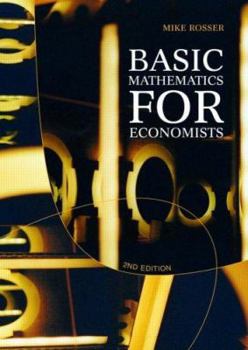
Basic Mathematics for Economists


While economists are not always expected to be mathematical geniuses, it is generally accepted that some basic mathematical knowledge is necessary. Basic Mathematics for Economists recognizes that not... This description may be from another edition of this product.
Format:Paperback
Language:English
ISBN:0415084253
ISBN13:9780415084253
Release Date:January 1993
Publisher:Routledge
Length:496 Pages
Weight:1.44 lbs.
Dimensions:6.1" x 9.2"
Customer Reviews
1 rating
Basic Math For Econ (2nd Edition, pb)
Published by Thriftbooks.com User , 22 years ago
The author does a pretty good job of presenting the basic mathematical techniques for economics students. The explanations are, for the most part, clear and understandable. The mathematics covered in this book ranges from the very basic to the more advanced topics.Although the author starts off with the most basic math, there are, nevertheless, more advanced concepts introduced within these basic chapters. For example, the chapter on arithmetic not only covers the basic elements of arithmetic but also has sections on the elasticity of demand and logarithms. However, it is unfortunate that the author combines the most basic math with the more advanced topics within the same chapter.At the beginning of each chapter, the learning objectives are presented. The book contains many examples and exercises, and with few exceptions the author provides the answers to all the exercises unlike other books that give the answers only to selected problems.In reading this book certain assumptions are made. For example, the author uses Excel in some of the chapters and it is assumed that the student has some prior knowledge of using this software package. Also, it is assumed that the student has some knowledge of economics.There are certain areas in this book that can be a matter of confusion for readers. First, the author uses two different symbols for the square root, i.e., a check mark and the more familiar traditional square root symbol. Second, the author does not clearly explain when the antilog in division is taken or not taken when using logarithms. Third, an example on matrix algebra shows calculated numbers to two decimal places when, in fact, these numbers are actually carried out to more than two decimal places for purposes of getting the final answer. This can be frustrating to students trying to understand the example if they are not aware that the author has done this. Fourth, there are some errors in the book. It is important that readers be aware of these types of problems.However, overall the mathematics is explained clearly. In addition, the author provides remedial math topics for those students needing such a review. Therefore, I would recommend this book.
Copyright © 2026 Thriftbooks.com
Terms of Use | Privacy Policy | Do Not Sell/Share My Personal Information | Cookie Policy | Cookie Preferences | Accessibility Statement
ThriftBooks ® and the ThriftBooks ® logo are registered trademarks of Thrift Books Global, LLC
ThriftBooks ® and the ThriftBooks ® logo are registered trademarks of Thrift Books Global, LLC
