


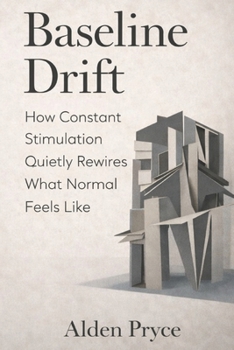
Baseline Drift: How Constant Stimulation Quietly Rewires What Normal Feels Like

Nothing feels wrong. Yet calm feels thin. Pleasure fades quickly. Silence feels oddly uncomfortable.
Baseline Drift explains why this happens without diagnosing you, motivating you, or asking you to opt out of modern life. It names a quiet shift that occurs when constant stimulation slowly recalibrates what your nervous system considers normal.
This is not burnout. It is not depression. It is not addiction. It is adaptation.
When stimulation becomes continuous, the threshold for sensation rises. Calm loses contrast. Rest stops restoring sensitivity. Ordinary experiences register less deeply even when life is stable and functioning.
Alden Pryce traces how baselines form, how they drift upward, and why adding more stimulation only deepens the problem. The book shows why common explanations fail, why rest alone does not reset the system, and why many capable adults misinterpret muted experience as boredom, aging, or personal decline.
This book does not offer hacks or prescriptions. It offers orientation. By understanding how baseline drift works, readers stop mislabeling themselves and start recognizing the conditions that quietly reshape perception, judgment, and mood.
If life feels flatter than it should without being broken, this book explains why.
Customer Reviews
ThriftBooks ® and the ThriftBooks ® logo are registered trademarks of Thrift Books Global, LLC
