


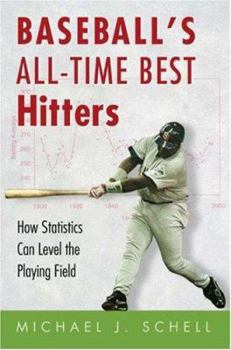
Baseball's All-Time Best Hitters

Select Format
Select Condition 
Book Overview
Tony Gwynn is the greatest hitter in the history of baseball. That's the conclusion of this engaging and provocative analysis of baseball's all-time best hitters. Michael Schell challenges the traditional list of all-time hitters, which places Ty Cobb first, Gwynn 16th, and includes just 8 players whose prime came after 1960. Schell argues that the raw batting averages used as the list's basis should be adjusted to take into account that hitters played in different eras, with different rules, and in different ballparks. He makes those adjustments and produces a new list of the best 100 hitters that will spark debate among baseball fans and statisticians everywhere. Schell combines the two qualifications essential for a book like this. He is a professional statistician--applying his skills to cancer research--and he has an encyclopedic knowledge of baseball. He has wondered how to rank hitters since he was a boy growing up as a passionate Cincinnati Reds fan. Over the years, he has analyzed the most important factors, including the relative difficulty of hitting in different ballparks, the length of hitters' careers, the talent pool that players are drawn from, and changes in the game that raised or lowered major-league batting averages (the introduction of the designated hitter and changes in the height and location of the pitcher's mound, for example). Schell's study finally levels the playing field, giving new credit to hitters who played in adverse conditions and downgrading others who faced fewer obstacles. His final ranking of players differs dramatically from the traditional list. Gwynn, for example, bumps Cobb to 2nd place, Rod Carew rises from 28th to 3rd, Babe Ruth drops from 9th to 16th, and Willie Mays comes from off the list to rank 13th. Schell's list also gives relatively more credit to modern players, containing 39 whose best days were after 1960. Using a fun, conversational style, the book presents a feast of stories and statistics about players, ballparks, and teams--all arranged so that calculations can be skipped by general readers but consulted by statisticians eager to follow Schell's methods or introduce their students to such basic concepts as mean, histogram, standard deviation, p-value, and regression. Baseball's All-Time Best Hitters will shake up how baseball fans view the greatest heroes of America's national pastime.
Format:Hardcover
Language:English
ISBN:0691004552
ISBN13:9780691004556
Release Date:March 1999
Publisher:Princeton University Press
Length:328 Pages
Weight:1.60 lbs.
Dimensions:9.0" x 1.3" x 6.0"
Customer Reviews
5 ratings
One of the best baseball books ever written
Published by Thriftbooks.com User , 17 years ago
Baseball fans love to engage in "who's the best" debates. When I was young, that was the primary topic of conversation between the boys in my neighborhood. Since we did not have a great deal of knowledge concerning the history of the game, our debates were primarily over the current teams and players. Occasionally, we did delve into the "of all time" areas, but our arguments were always weakened by issues such as the differences in the ballparks and how the game had changed over the years. We always considered these issues to be ones that we could not resolve, so little time was spent on them. In this book, statistical techniques are used to adjust for the differences in the era, different ballparks and how the rules have changed over the years. The conclusions are somewhat surprising and while they can be controversial, it is difficult to argue with the methods used to arrive at the conclusion. Schell's conclusion is that Tony Gwynn is the best hitter of all time. Tables abound, demonstrating statistics adjusted for the appropriate changes. Some of the most astounding statistics are those regarding the effect that a ballpark can have on a career. On page 190, there is a synopsis concerning Fenway Park, the home of the Red Sox. It was a park that favored the pitchers until 1934, when there was a major renovation. Since 1934, one-third of the American League batting champions was a member of the Red Sox. Coors Field, the home of the Colorado Rockies, is the best park for hitters, a conclusion easily supported by the data. For all three years covered in this book, the Rockies won the team batting title and the individual title was a race between Tony Gwynn, Mike Piazza and someone from the Rockies. As a lifelong baseball fan and a teacher of statistics, I loved this book. It is also not necessary to completely understand all of the statistical concepts to appreciate the conclusions. There is also a list of the best players based on each position other than pitcher, although all outfielders are grouped together. Schell lists "Actual and Recommended Hall of Fame ***" where *** is the given position, based on the statistical adjustments he has performed. Although there is some room for controversy regarding Schell's conclusions, he provides a fascinating look into how the game has changed over time and how it can change from ballpark to ballpark.
a stats book on baseball
Published by Thriftbooks.com User , 18 years ago
Most baseball fans like statistics, so it should not be a disappointment to them to find out that this is an elementary statistics book where the statistical methods are taught to explain how to adjust batting averages in order to compare players in terms of their batting averages. The average baseball fan would be interested in comparisons of Ty Cobb, Tony Gwynn, Ted Williams and others who are acknowledged as the best hitters for average in the game. Schell considers factors that make direct comparisons unfair and he provides methods to adjust for these factors based on the vast amount of statistical data available to him that has been gathered throughout the history of major league baseball. Key effects include the home ball park, stage of career and interventions such as the lowering of the pitcher's mound after 1968. To adjust for players whose abilities decline substantially in the latter years of their career Schell uses only the first 8000 at bats to gauge the players hitting ability. This helps players like Mickey Mantle whose performance declined appreciably at the end of his career due in part to injuries. Schell provides a lot of interesting statistics and comparisons. Ty Cobb had the highest lifetime batting average but after all the adjustments finishes second to Tony Gwynn, a result that will surely create controversy. Nevertheless Schell's approach makes sense and his results are not too surprising. As he notes his adjustments move many of the modern players whose numerical averages are lower than the players from the late 1800s and early 1900s, ahead on the list. Schell relates how he showed up to meet and congratulate Gwynn on the date of his 8000th at bat when he clinched first place based on the Schell adjustment system. Mike Schell is a sports enthusiast and a professor of biostatistics at the University of North Carolina. In 2002 he was one of the invited speakers at the Sport Statistics Section Session of the Joint Statistical Meetings. This book was published just one month after his other book on home run hitters. The methodology is quite similar. This book got a lot more fan fare due to the publicity regarding Tony Gwynn.
...but you missed the point...
Published by Thriftbooks.com User , 20 years ago
Of course on-base and slugging percentages are much better measures of a hitter's worth, but that's not the author's point. He wants to take a particular statistic and show how it should be interpreted/reinterpreted, given the vagaries of time, location, etc. He could easily have chosen on-base, slugging, OPS, whatever, but batting average traditionally is the first one everyone looks at, as ill-informed as that may be. Implied is that the same arguments can be used for any of the other statistics. (And he does so, briefly providing the results.)
Best of its kind
Published by Thriftbooks.com User , 21 years ago
This is the most painstakingly objective attempt I have ever seen to level the playing field when comparing players across eras. The criticisms that have been levelled against it are unjustified. First, the complaint is made that only batting averages are being considered, not on base percentage or hitting for power (slugging average). In the first place, that's not entirely true- he also runs an analaysis of on base percentages, and devotes a separate chapter to this - leaving me to wonder if the one critic who blasted the author for not considering on base percentages has even read the book. Secondly, the book is about batting averages, so of course the main focus is on -batting averages. Thirdly, another book will be forthcoming from the author on slugging averages. The other criticism - that the book is "for nerds only" - is just an indication of who the target audience is. Not every book is written for everybody. If you like baseball and are a stats junkie and like to argue about this player being better than that player, then this book is for you. If you don't like baseball and aren't a stats junkie and don't like such arguments - then the book is NOT for you. For what it is - comparing batting averages and on base percentages of different players from different eras - it is the best of its kind.
Superb game-rainout reading material
Published by Thriftbooks.com User , 26 years ago
Admittedly, you'd better love either baseball or statistical analysis to get into this book. It represents an alternative to the George Will "baseball is America" romantic view of the game, and provides interesting fodder for barroom debate. The math is well beyond me, but, like the , the results are well worth review. Unlike the , this book is more than just a reference, it is also an interesting read.
Copyright © 2026 Thriftbooks.com Terms of Use
| Privacy Policy | Do Not
Sell/Share My Personal Information | Cookie Policy | Cookie Preferences | Accessibility Statement
ThriftBooks® and the ThriftBooks® logo are registered trademarks of Thrift Books Global, LLC
ThriftBooks® and the ThriftBooks® logo are registered trademarks of Thrift Books Global, LLC
