


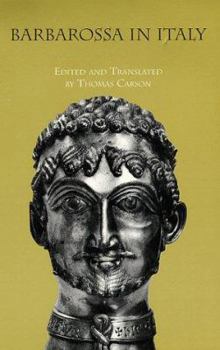
Barbarossa in Italy

Select Format
Select Condition 
Book Overview
"Barbarossa in Italy" presents a verse translation of the "Carmen de gestis Frederici I imperatoris in Lombardia." This Latin poem describes the conflict leading up to Apriil of 1162 when Frederick I... This description may be from another edition of this product.
Format:Paperback
Language:English
ISBN:0934977305
ISBN13:9780934977302
Release Date:September 2008
Publisher:Italica Press
Length:234 Pages
Weight:1.70 lbs.
Dimensions:0.5" x 5.5" x 8.5"
Customer Reviews
1 rating
A Latin Literary Epic of the 12th Century
Published by Thriftbooks.com User , 18 years ago
Barbarossa in Italy, a Latin historical epic from around 1160, was written by an unknown author from Bergamo, Italy. It covers the events of Emperor Frederick I's (Barbarossa's) two Italian campaigns (1154-1162) and the history of Bergamo's conflict with Milan. The text (the Latin is sadly not included) is written in almost perfect dactylic hexameter (the same meter as Vergil's Aeneid). Barbarossa in Italy, although a piece of poetry, contains a large amount of information not found in other sources. The editor claims that this is "one of the earliest, if less detailed, independent sources of Frederick's Italian journeys, and it should have equal status with the Gesta Frederici of Otto of Freising," (pg XXIX). This work is the result of the so-called Twelfth Century Renaissance a time which saw a rebirth of Classical sources (not THE Renaissance of the 15th century). The author has a distinct bias towards Barbarossa for he omits many of the Emperor's military and political disasters during his campaigns. The text is chalk full of references to Homer, Statius, Vergil, Lucan, and has a few references to the Bible. Historical background: Barbarossa ruled what we now call Germany from 1153-1190 during a period of civil war between two important families and the lengthy Investiture Conflict with the Pope. Barbarossa saw the expedition to Italy were he was to be crowned by the pope as a way to gain recognition, power, and military conquest. Also, he saw himself as an heir to the glory of Constantine and other great Roman Emperors. The first expedition began in 1154 as a result of the Treaty of Constance where it was agreed that Pope Eugenius III was to crown him emperor and in return the German king was to defeat the communal revolts occurring in Northern Italy. The rise of communes is a common event in Italy (and northern Europe) at this time. The wealthy members of the city (such as Milan) would band together and promote the independence of their city and impose their will on surrounding areas. The campaign was a disaster (besides the coronation). The second expedition achieved equally little (although a few military victories) since it failed to defeat their primary rivals for power in the Italian peninsula, the Normans. Thomas Carson's Introduction: The introduction to this epic is immense and relatively easy to read for those who are not very familiar with the time period. The historical background is provided along with other historian's interpretations of the importance of the text, the editor's perspective on the historical importance, the literary merit, a map etc. The only missing analysis from this amazing introduction is a detailed paragraph or two on the actual Latin used. For Latin readers, such as myself, this would be an interesting and valuable section. This type of analysis is present in most other scholarly introductions to Latin primary sources. All in all, this is a remarkable source in both its literary and historical facets. Th
Copyright © 2026 Thriftbooks.com Terms of Use
| Privacy Policy | Do Not
Sell/Share My Personal Information | Cookie Policy | Cookie Preferences | Accessibility Statement
ThriftBooks® and the ThriftBooks® logo are registered trademarks of Thrift Books Global, LLC
ThriftBooks® and the ThriftBooks® logo are registered trademarks of Thrift Books Global, LLC
