


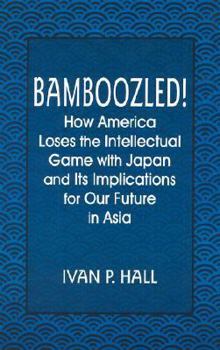
Bamboozled!: How America Loses the Intellectual Game with Japan and Its Implications for Our Future in Asia

Select Format
Select Condition 
Book Overview
This work illuminates the ways in which American ideological hubris and Japanese pleading for special treatment combine to deprive trans-Pacific dialogue of honesty, openness and common sense. It questions how well the US is prepared to deal with less friendly emerging powers like China and India.
Format:Paperback
Language:English
ISBN:076561006X
ISBN13:9780765610065
Release Date:September 2002
Publisher:Routledge
Length:336 Pages
Weight:1.07 lbs.
Dimensions:0.8" x 6.0" x 9.1"
Customer Reviews
5 ratings
for reasons I later explain
Published by Thriftbooks.com User , 21 years ago
Ivan Hall's latest book should prove to be controversial for a number of important reasons, chief of which is his contention that Japan continues to outwit and outflank the United States on trade and other important economic matters. He further contends that Japanese society is constructed in such a manner that voices of dissent are stifled, that a large number of American academics, journalists and diplomats have been either bought, bought, beguiled or bamboozled by their Japanese counterparts into being proponents of Japanese neo-mercantilist policies. Hall is clearly not among that number. Instead of accepting the prevailing orthodoxy that Japan is suffering from a prolonged recession, Hall believes that the Japanese economy is as buoyant as it ever was. Although he cites countless examples to show where Japanese industry continues to outpace her rivals, his main points are that a large coterie of journalists, academics and other commentators are deceived by Japanese spin doctors into believing that Japan is economically weak and that those deceived commentators assist Japan in continuing to accumulate vast trade surpluses with almost every other country in the world. Although he is right to dismiss those who are beguiled by tea ceremonies, geisha girls and the other accoutrements of Japan's "soft diplomacy", he appears not to give some underlying socioeconomic imperatives their due weight. Prior to Perry's Black Ships, Japan was not invaded, solely because she was too strong to be invaded. When Perry forced the Japanese to engage with the world, the Japanese proved to be excellent students. When Japan's armies marched in to Korea, China and other countries to build, at bayonet point, markets for Japanese goods, the Japanese were merely copying the prevailing imperialist orthodoxies of the Dutch, British and Americans. Hall's book would have been considerably enhanced by acknowledging that Japanese imperialism was, in essence, no different from the prevailing European or American varieties. When Japanese mercantilism ended in 1945, the Americans forged Japanese economic policies to serve America's own ends. The emergence of Communist China and the Korean war reinforced Japan's new, American inspired neo-mercantilist role: sheltering under the Pax Americana, Japan now exported its transistor radios and Honda motor bikes to the four corners of the globe. Japan is still doing that. Because the United States is the world's most important market, much of Japan's exports go to the United States and Japan, quite naturally, expends quite a lot of resources in "soft diplomacy" guaranteeing and solidifying those markets. The Japanese endow American universities and wine and dine journalists so that they will not bite the Japanese hand that gives them succor. Although Hall makes the important point that no other country does this to the same degree, Japan is the world's second largest economy: no other country could, in other words, afford to do so.
The Bamboozled vs the Bamboozlers
Published by Thriftbooks.com User , 21 years ago
Hall continues here in the vein he began mining in Cartels of the Mind. Hall has spent some thirty years in Japan. In that time, he has worked as a diplomat, journalist, and university professor. In Cartels, Hall argued that Japan was not playing fair in its treatment of foreign professionals. He looked specifically at the obstacles to foreign lawyers, journalists, businessmen, and academics working in Japan-versus the freedom their Japanese counterparts enjoyed in the US. In the current text, Hall takes his scalpel to Japan's propaganda system, which he believes distorts the US-Japan relationship. Moreover, in particular, he dissects the effects of American myopia on the relationship, and the largesse Japanese companies and institutions bestow on American universities. This excellent text is for the serious student of Japan, for those who engage Japan on a more than a superficial level, and for any students who seek to understand a non-Western culture.
This is not Japan bashing
Published by Thriftbooks.com User , 22 years ago
Ivan P. Hall is no Japan basher. Those who write off this book as being shallow and unduly negative haven't seriously read his thesis or thought about his arguments. His thesis is not only spot on correct, but he shares it with a rare eloquence that is a joy to behold. I would recommend this book to anyone interested in a clear thinking powerful writer, whether they care about Japan-US relations or not. This is a great book.
An argument of historic importance
Published by Thriftbooks.com User , 22 years ago
In advance of Bamboozled's publication, the publisher asked me to contribute a comment for the cover. Here in full is what I wrote: ====Written with rare wit and panache, this book is an intellectual box of chocolates for serious Japan watchers. Drawing on more than thirty years of on-the-spot Japan-watching experience as a diplomat and scholar, Ivan Hall expertly rips into the Tokyo-based propaganda czars who for decades have controlled what we think we know about Japanese economics and politics. Speared too are the naifs, dupes, and charlatans who now dominate Japan studies programs at American think-tanks and universities. ====Precisely because this book makes an argument of historic importance, many people desperately do not want you to read it. Of course, they dare not engage in a serious, honest argument about the book's contents. To do so would merely underline how devoid of reason their criticisms are. Instead the critics try, by unsubstantiated and utterly mendacious ad hominem slurs, to persuade you not to buy the book in the first place. That way you will never know what an important book this is. The essence of Hall's argument is that during the 1990s and even into the new century the Japanese establishment absurdly exaggerated Japan's economic distress in an effort to deflect American pressure on trade. That Hall has a point is obvious to every foreigner who visits Tokyo these days: despite 13 years of "slump," the Japanese people have somehow so improved their living standards that they now clearly rank among the world's richest consumers. Just the most obvious manifestation of their wealth is their life expectancy, now the world's highest and up 14 years since the late 1940s. As for Japan's burgeoning ability to project economic power abroad, just one statistic tells the story: Japan's net foreign assets have tripled since the "slump" began.To understand the full significance of Hall's work it is important to know the field in which he works. Japan watching is suffused with Japanese money -- money that shapes what is taught in American universities, what is said in American forums, what is published in American books and newspapers. Virtually alone among America's Japan-watching scholars, Hall has spurned this money. Saying "No" to the inflated speaking fees and the generous academic subventions that Tokyo showers on those who serve its propaganda agenda, Hall has chosen a way of life that hardly leads to riches. But he possesses something much more precious -- and in Japan studies much rarer -- than riches: a reputation for uncompromising integrity.More prosaically the practical Japan-watching credentials he brings to the subject are second to none. These include not only a Harvard doctorate in Japanese history but, what is even more useful, several decades of school-of-hard-knocks experience as a Tokyo-based Japan watcher. A hint of how important this book is can be gleaned from who has been criticizing it. On the one hand
A Masterpiece
Published by Thriftbooks.com User , 23 years ago
While much is overrated, Ivan Hallfs gBamboozled,h cannot be. Ivan Hallfs critical and compelling tome examines Americafs frequently misguided relationship with our greatest economic rival in the world today. gBamboozled,h is required reading for anyone seeking to understand Japan.
Copyright © 2026 Thriftbooks.com
Terms of Use | Privacy Policy | Do Not Sell/Share My Personal Information | Cookie Policy | Cookie Preferences | Accessibility Statement
ThriftBooks ® and the ThriftBooks ® logo are registered trademarks of Thrift Books Global, LLC
ThriftBooks ® and the ThriftBooks ® logo are registered trademarks of Thrift Books Global, LLC
