


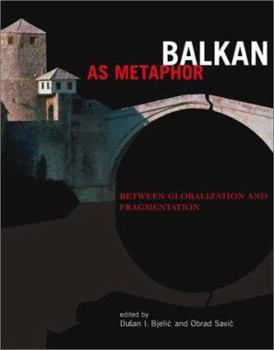
Balkan as Metaphor: Between Globalization and Fragmentation


Select Format
Select Condition 
Book Overview
Balkan. Somewhere between a tragedy and a myth, a place and a condition, the term is perhaps best understood as a metaphor. It has been used and abused in academia by proponents of opposing political views. Multiculturalism has appropriated it, as have postmodernism and postcommunism. It is used perjoratively to refer to excessive specialization and nostalgically to refer to Europe's lost people - its wild warriors and passionate geniuses. This book explores the idea of the Balkan as metaphor and the meaning of Balkan identity in the context of contemporary culture. Focusing on Balkanism both as a body of knowledge and as the critical study of that discourse, this book does for the Balkans what Edward Said's Orientalism did for the Orient.
Format:Hardcover
Language:English
ISBN:0262025248
ISBN13:9780262025249
Release Date:September 2002
Publisher:Mit Pr
Length:350 Pages
Weight:1.70 lbs.
Dimensions:9.0" x 1.3" x 7.0"
Customer Reviews
1 rating
More than mere metaphor
Published by Thriftbooks.com User , 18 years ago
In the context of the Balkan wars, Renata Salecl outlined the problematic of what she termed "the fantasy structure of the homeland." (11-12) She argues that the nation is based on a kind of social fiction--essentially a narration about this land which, in Lacanian terms, she defines as fantasy: the attempt to symbolise or flesh out the emptiness of reality. Bjelic and Savic's edited volume is a timely and autoratative addition to the literature on the Balkans, especially their central thesis: that the Balkans has taken on a certain fantasy structure, not of the homeland, but of the underbelly of Europe or the western other. That 'Balkanism' (akin to but different than Said's 'orientalism' - a great companion piece to Maria Todorova's Imagining the Balkans [Oxford, Oxford U Press, 1997])- has cast the region in the eyes of all who look from without as some perverse and alien region where vampires (Serbs) lurk in dark corners (Toma Longinovic's piece 'Vampires Like Us: Gothic Imaginary and "the serbs"') and Balkan thinking comes from the sweaty loins of porn-fed chetniks (Rastko Mocnik and Dusan Bjelic and Lucinda Cole's pieces here are noteworthy). It outruns Salecl's thesis and her ex Zizek's lapidary comments about the place and is a substantial intellectual endeavour. A late arrival on the scene, the book is however timely as some dust has settled in the region and some reflective space allowed (perhaps). As it comes from within cultural studies and critical theory discourses, it's an important text for a broader reading of culture than just the Balkans.
Copyright © 2025 Thriftbooks.com
Terms of Use | Privacy Policy | Do Not Sell/Share My Personal Information | Cookie Policy | Cookie Preferences | Accessibility Statement
ThriftBooks ® and the ThriftBooks ® logo are registered trademarks of Thrift Books Global, LLC
ThriftBooks ® and the ThriftBooks ® logo are registered trademarks of Thrift Books Global, LLC
