


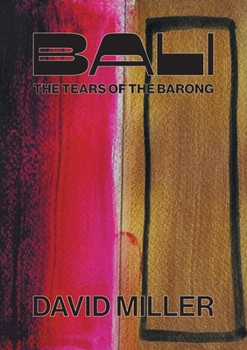
Bali: The Tears of the Barong

BALI: The Tears of the Barong is a collection of visual works by Australian-born artist and poet David Miller, bringing together paintings made in ink on paper, with pencil and collage, alongside a poem from his sequence Confrontation. Miller's visual work has appeared in books by Fanny Howe, Robert Lax, Isadore Lhevinne and Peter Barry, as well as in journals including BlazeVOX, ETC, Golden Handcuffs Review and Poetry Salzburg Review.
Like the Venice ("lantern-slide visions") of Robert Duncan's Venice Poem, David Miller's Bali is an island of the imagination; and as Duncan builds his poem out of Venice's central Piazza San Marco and associated artworks, so Miller brings his own visuals to bear on Bali's presiding exorcist myth, whereby every year the Barong, a guardian spirit often figured as a lion with mirror-studded textile mane, drives away Rangda, the witch who figures chaos. That the exorcist's victory can never be final may offer one way into Miller's bewitching sequence of inkings, which opens with two intense and contrarily suggestive reds facing off, continues through vertical panels each featuring some oddball insert ... goes horizontal before holes and negatives set in, but by then colour-and-shape intensities may have returned us to our own version of Hans-Georg Gadamer's "The work of art that says something confronts us itself."
GILBERT ADAIR
Bali presents the poetic imperative of a spoken but a-linguistic intimacy, otherwise and beyond the poem 'Confrontation' from which Bali draws its epigraph. Engaging with it is a cumulative series of lessons in seeing, because what you see is what you get, and as Miller takes responsibility for these encounters, so must we. There is a necessary jeopardy in this process of making and seeing: the jeopardy of, the jeopardy in, such a communion, in the effect of each image and the movement from image to image: their presence and inter-relation. Here is the dynamic interplay of the determinedly accidental and the accidentally determined, of collaging within and between pieces, incursions that assert and inform, of landscaping, diagrammed inscribed encrypted. We feel the weight of threads of colour - predominantly rose-pink, with and against shades of soft and vibrant green, bright yellow and deep black (which, paradoxically, often resonates with these other colours) - and the finely balanced articulation of the ground they cover, the intra-relations of presence and absence. There are haunting textural presences, gestures that tentatively enter and then assert or overwhelm, the tension between intense colour and the blank page. Rose-pink exposing itself with acid yellow, the power of a fragile line contending against the scale of a heavy black void, a fragile black boundary between them.
PATRICIA FARRELL
Customer Reviews
ThriftBooks ® and the ThriftBooks ® logo are registered trademarks of Thrift Books Global, LLC
